Brits going to Spain at May bank holiday: you're probably paying too much for car hire

As regular readers of this blog are surely now aware, I have become quite fascinated by the tricks used by car hire companies to wring more money out of their customers. I first reported on this in summer 2014, and revisited the example in early February 2015. I have since looked into the term known as "Source Market Pricing" - i.e. determing the price of car hire based on where the car is booked, not on the basis of demand where it is actually hired.
To test this Source Market Pricing, I looked at car hire prices on UK May Bank Holiday weekend - in 2015 that is Monday 25th May. I hence searched for a Class B car (VW Polo, Opel Corsa or equivalent) for 4 days at Malaga Costa Del Sol Airport in Spain, collecting the car at 0800 on Saturday 23rd May, and dropping it off on Tuesday 26th May at 1800. No extras were added.
Prices were compared from Spanish, German, British and Swedish websites of Hertz, Avis and Europcar. In the case of Hertz and Avis this meant the .es, .de, .co.uk and .se homepages. In the case of Europcar is additionally involved setting country of residence in the search form. All prices were checked on 17.2.2015, and exchange rates are the Interbank rates. Sweden is an important test case - to show the results are not just as a result of exchange rate variations.
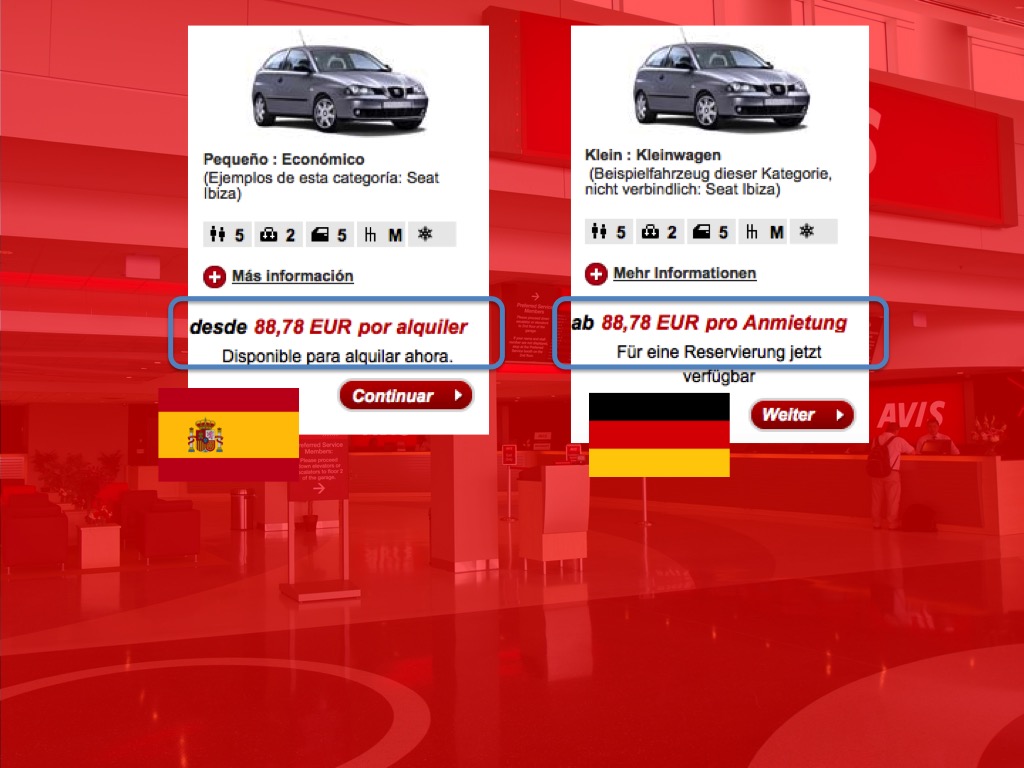
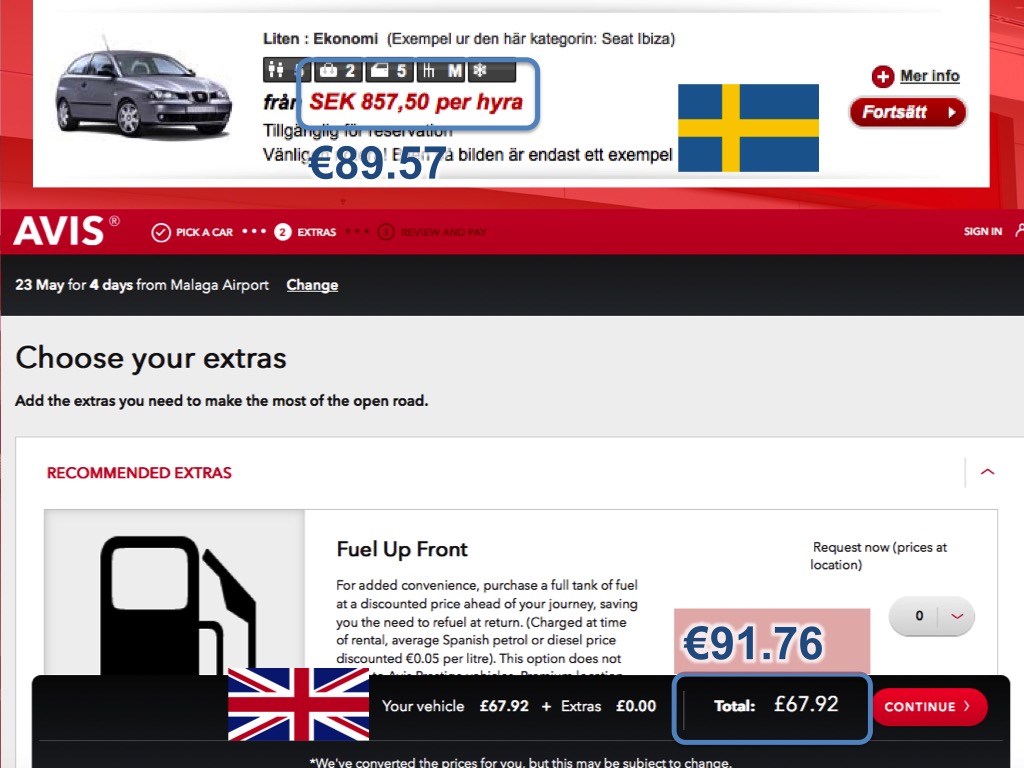
Avis
Only one price is offered per search. All unlimited kilometres included.
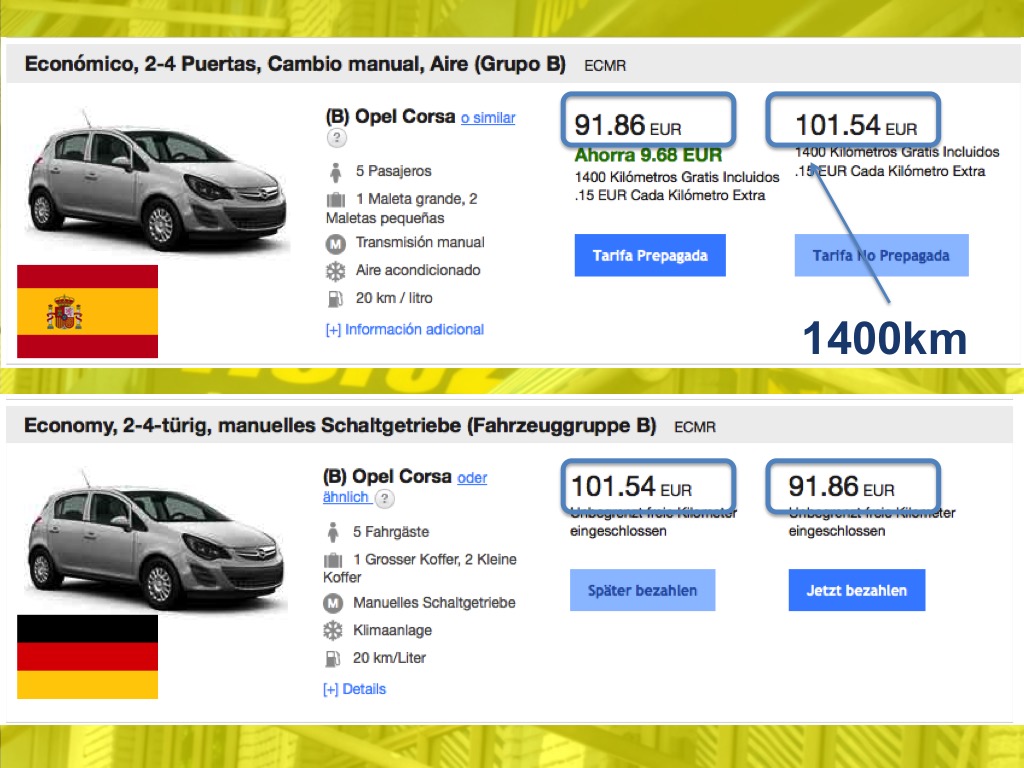
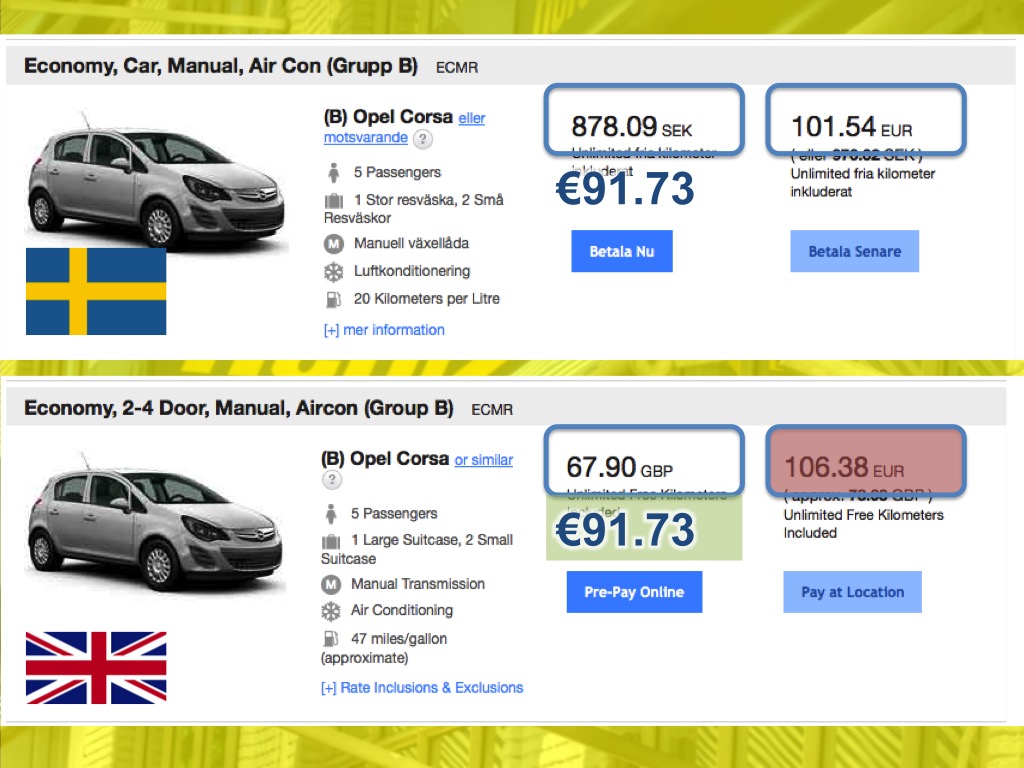
Europcar
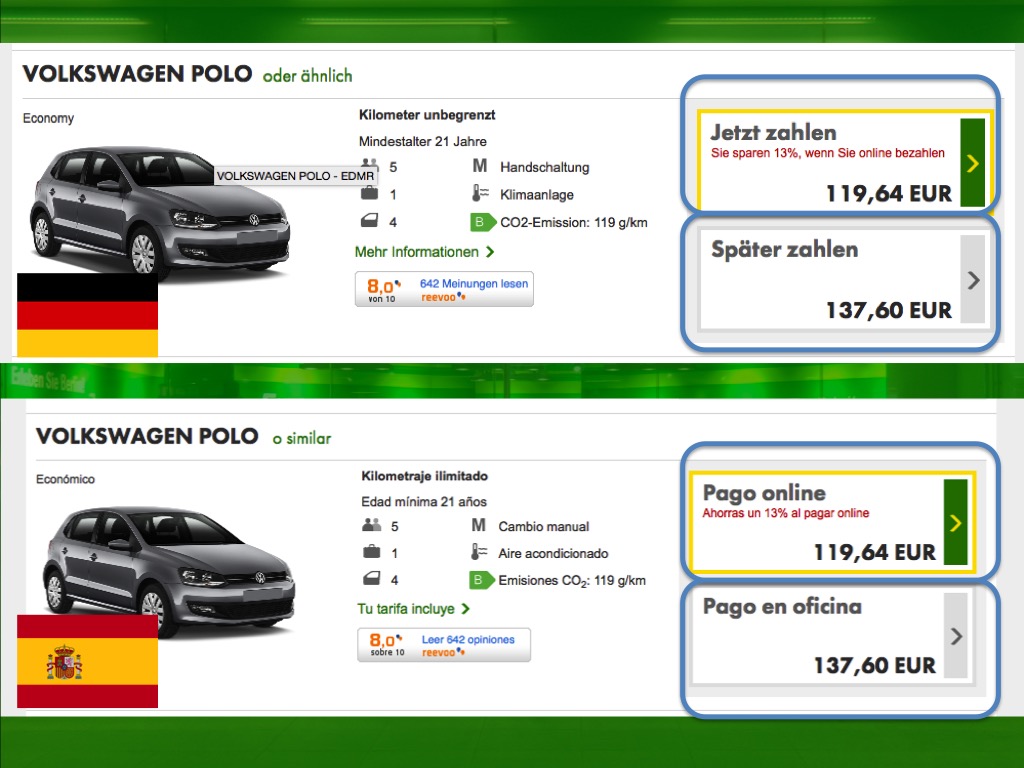
Difference between 'book now' and 'book on the spot prices'. 'Book now' unavailable off the Swedish website. All unlimited kilometres included.
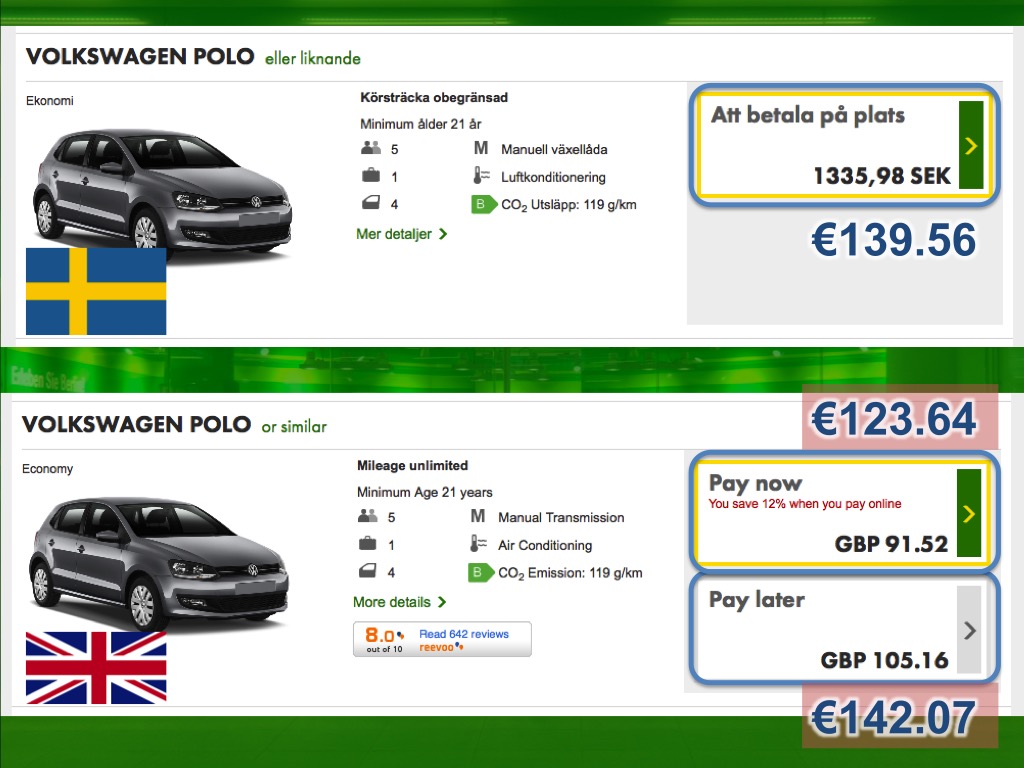
Hertz
Difference between 'book now' and 'book on the spot prices', although both options available on all websites. Spanish site offers 1400km included, rest unlimited.
Conclusions
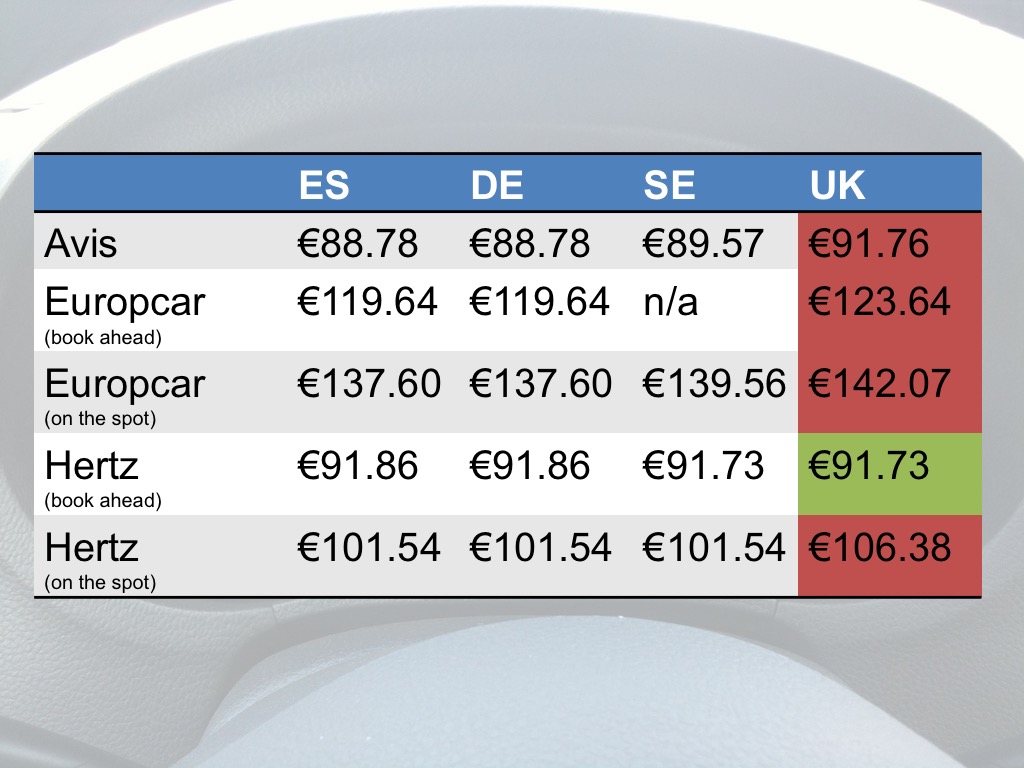
In 4 of the 5 cases (Avis, both Europcar, on the spot Hertz) prices for the UK are the most expensive. In only the case of Hertz book now are prices equivalent between the UK and the three other sites. The maximum price differential is just under €5 - I will re-run this experiment each month between now and May to see if this increases.