How to organise a rail replacement bus service (Schienenersatzverkehr)

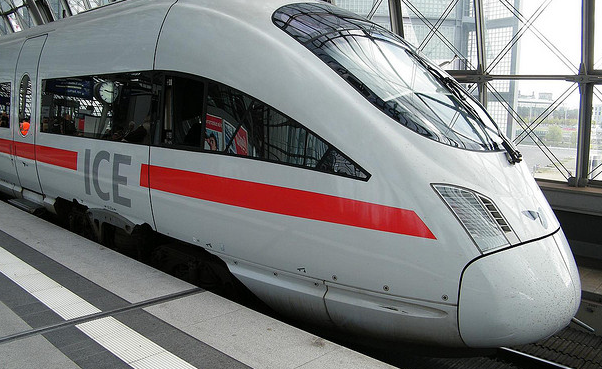
ICE36 train, departing 0944 from København H to Hamburg Hbf will not be able to run any further than Rødby on the Danish side of the Fehmarn Belt, and all passengers will have to board the ferry on foot instead of in the train, and take a replacement bus on the German side.
This was the predicament I faced earlier today. Here is how, I reckon, the whole thing should be organised. Then I will explain what actually did happen.
What should have happened
First of all, information to passengers needs to be provided as early as possible – i.e. as soon as the problem is known. In the case of the København H – Hamburg Hbf service this means communicating with the DSB staff that man the train as far as Rødby to inform them what will happen on the German side. This will also mean that station signs in Denmark should read “Rødby, with bus connections to Hamburg Hbf” and not “Hamburg Hbf”.
At Rødby a member of DSB staff or two must guide passengers to the ferry, especially those with luggage who will additionally have to lug it along the long walkways. (Also the signposts at Rødby when leaving the train are not especially clear).
On board the ferry an announcement can be made for train passengers explaining what to expect when they arrive on the other side, and apologising for the inconvenience.
While all this is going on, DB can prepare its rail replacement buses in Puttgarden. It can look in its ticketing database to see how many people are booked on the train, and then add 10% for people just turning up and getting on. Or it could radio the DSB staff to check how occupied the train is. Buses can then be booked accordingly.
Upon arrival at the bus stop, passengers need to be strictly divided into three groups: the first group is passengers travelling beyond Hamburg and with connections at Hamburg Hbf. These passengers need to be given priority on the first bus, and this bus needs to leave as soon as possible. Further buses need to be laid on according to need – some for Hamburg, and some for Oldenburg-Lübeck-Hamburg. The arrangement of these buses can be communicated to the passengers on board the ferry, and at the buses too, possibly with signs in the bus windows. Likely arrival times of the buses need to be communicated to DB customer services HQ, so decisions whether to hold trains in Hamburg Hbf can be planned accordingly – again this information could be gleaned from radio contact with DSB (see above) or by checking the booking database.
This strikes me as the fairest and simplest way to make sure as many passengers as possible get to their destinations as swiftly as possible. And it is not complicated.
This is what actually happened
The first announcement that the train would not go beyond Rødby was made literally 5 minutes before arriving there, so there was no way to fully explain to passengers what is going on, let alone check their onward connections for bus allocation (see above). Yet DB knew already from 8am in the morning that the train would go no further. Yes – information known for 4 hours was only given to passengers 5 minutes before it was needed. I confronted a DSB staff member about this in the ferry “We did not know before” he said. “I found out the DB information from a passenger!”
Yes, you read that right. DB had not informed DSB of what was going on, and a DSB staff member admitted this to me. It could of course be that DB had informed DSB, and DSB had not informed its train staff, but the end result is the same, and anyway it's extraordinary for one firm to just point the finger at another one.
Of course there were no DSB staff at Rødby to explain what was happening, and no luggage assistance for the elderly, and no announcement on board the ferry to tell everyone what was going to happen upon arrival.
Then, upon arriving in Puttgarden there were just 3 buses waiting. That of course was not enough for a 4 carriage ICE train so packed it was standing room only. DB could have known it needed more buses if it had spoken to the DSB train crew, but of course it had not. The train was packed all the way from Købernhavn H, leaving there a full three hours earlier – more than enough time to get a couple of extra buses provided. You could even have sourced some from Hamburg with this much time. This failure to provide adequate buses is hence inexcusable, and the fault lies squarely with DB.
2 buses were destined for Hamburg Hbf, and 1 for Oldenburg-Lübeck, but no prioritisation was made for passengers with onward connections in Hamburg, so the only DB member of staff present forced all three buses to wait 20 minutes while he tried to get confirmation that another bus was on the way for the remaining passengers. In the meantime those of us in the front bus with onward connections in Hamburg Hbf were going crazy – why aren't we leaving? “I have to get confirmation of another bus for the remaining passengers waiting” the DB guy told me, and “I need to take the bus too”. He needs to take the bloody bus? Sorry, but I don't give a damn if and when the employee gets the bus – at this point he received a mouthful of abuse from me in German for his incompetence organising the whole thing. Somehow the DB guy then let the second bus leave (and I had a seat on the first), so a fellow irate passenger and I grabbed our bags, hopped out of our bus and into the other one, and away it went.
Now the good news from all of this – I had 45 minutes to get my connection in Hamburg, so the bus actually got me to Hamburg Hbf 10 minutes before the scheduled departure of the IC train to Köln, so I was OK. The problem was that if I had not managed to get that IC I would have missed a further connection in Köln, and been stuck there. I don't know if the passengers from the other bus will have made it – I think I only managed thanks to being bloody minded and very insistent. Other passengers I spoke to, with connections to Berlin, Osnabrück and Kassel definitely missed their connections, and all of this could have been spared just a little bit of forward planning.
So here we are once again. I can tolerate things going wrong on the railway, but not having a sensible, basic plan of what to do, and a plan of how to communicate it to passengers, even when the problem has been known for hours, is absolutely out of order. DB and DSB you should be ashamed of your operations today.