Analysing railways with a Brexit diagram in my head

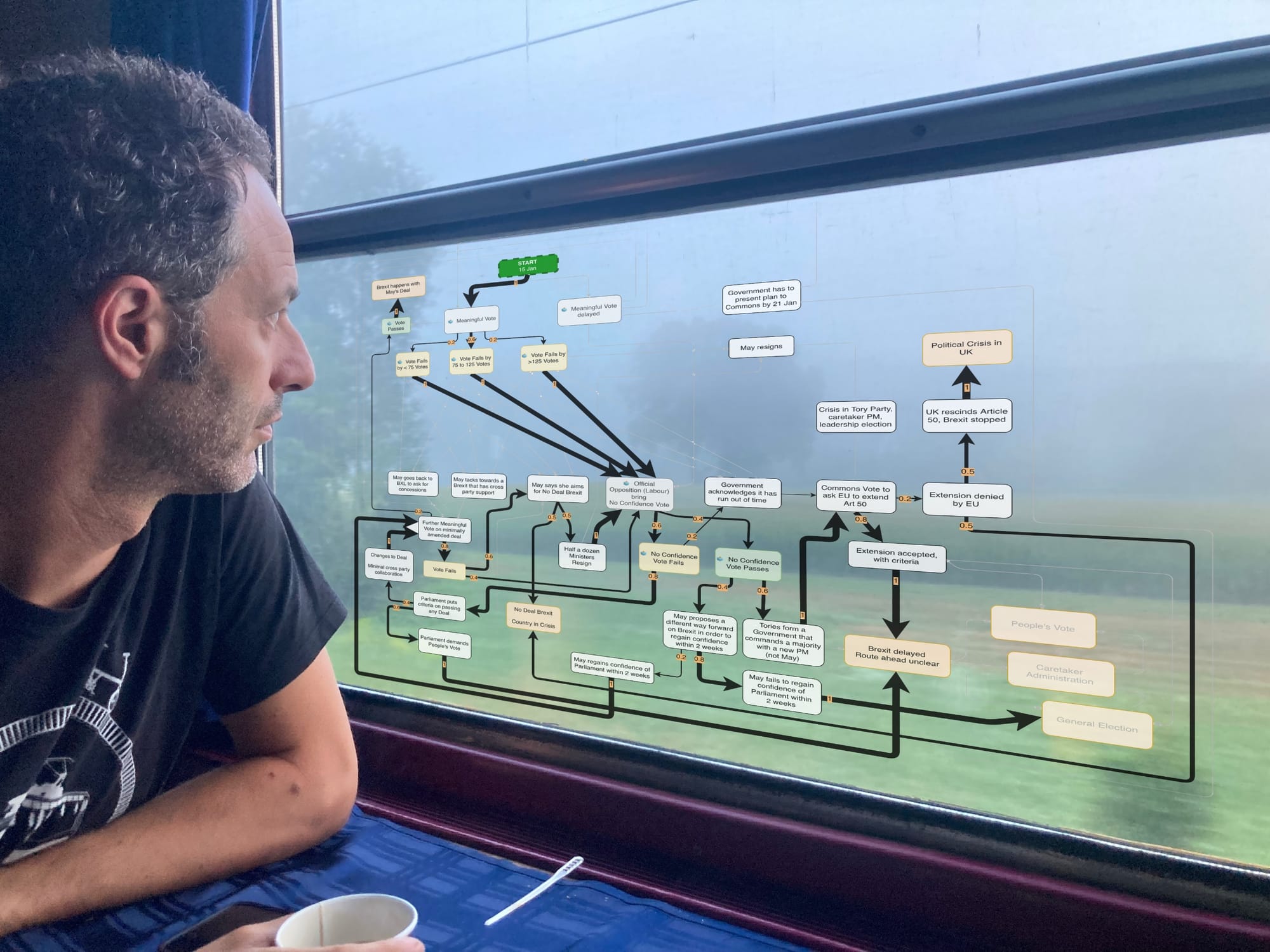
Why do I think Heuro Train's plans to run Amsterdam - Paris in 2030 are bullshit? Because I can see no way to think they can get any trains to run by then. An important building block for a route from today to running in 2030 is missing.
Why do I think Nox have a better chance? Because I can at least see what all the building blocks are to be able to run, although I admit that the chances some of the pieces fall into place are not 100% certain.
And this, while I have not articulated it this way before (a conversation this week with an old friend got me thinking about this), is basically applying my Brexit logic to railways.
For those who did not encounter my work during the Brexit years, I was known for a series of ever more complicated diagrams about Britain's efforts to exit the EU - you can find all of these diagrams here. The New York Times even wrote about the diagrams.
What doing this taught me was the importance of knowing what the stages of the process were, and how that was more important than the probability of each step. There was some point where John Bercow, out of the blue, refused a new vote in the House of Commons. My diagram had only a low chance of this happening, but - unlike other commentators - I at least knew what it meant that this route had been taken. And then once you know all of the boxes on your diagram, and which follows which, you can begin to assign probabilities.
And so back to railways.
I favour a tram train for Nijmegen - Kleve, because having worked out (and largely eliminated) all of the other options, it is the one with the best chance of success. It is why I have long been sceptical of the chances Freiburg - Colmar will ever re-open, because one crucial block - a new bridge over the Rhein - is missing. It is why, in my Channel Tunnel work, I favour a stop in Köln somewhere other than Köln Hbf for London bound trains. It is why, whatever the noise to the contrary, Ashford makes more sense than Stratford as an extra UK stop, and why I can obviously see that is a financial rather than technical question. I am sceptical about re-gauging railways not really out of principle, but because each of the stages to get there are so fraught with with difficulties.
And this leads to frustration with what I see or read elsewhere about trains. This video about Alstom's problems with the Coradia Max train deliveries sort of identifies the missing building block - the trains are not approved to run. But we are given no idea why this problem remains unsolved, or what pieces are missing before that approval can be achieved. Or why much of the reporting on Italo's entry into the German railway market is off - it ignores completely the building blocks about Germany's deficient infrastructure.
So that is what is going on in my head when there is a news story about railways.
It is about paths, building blocks, outcomes.
Is there, or is there not, a plausible path towards the stated outcome? And then, if there is, can I start to assign some probabilities. For me there is nothing unusual about this - it is just the way my mind works. It is just a never-ending frustration that rather few people trying to report railway news seem to take the same approach!