How to (re-)open a UK station for long distance Channel Tunnel trains (and why it still should be Ashford)

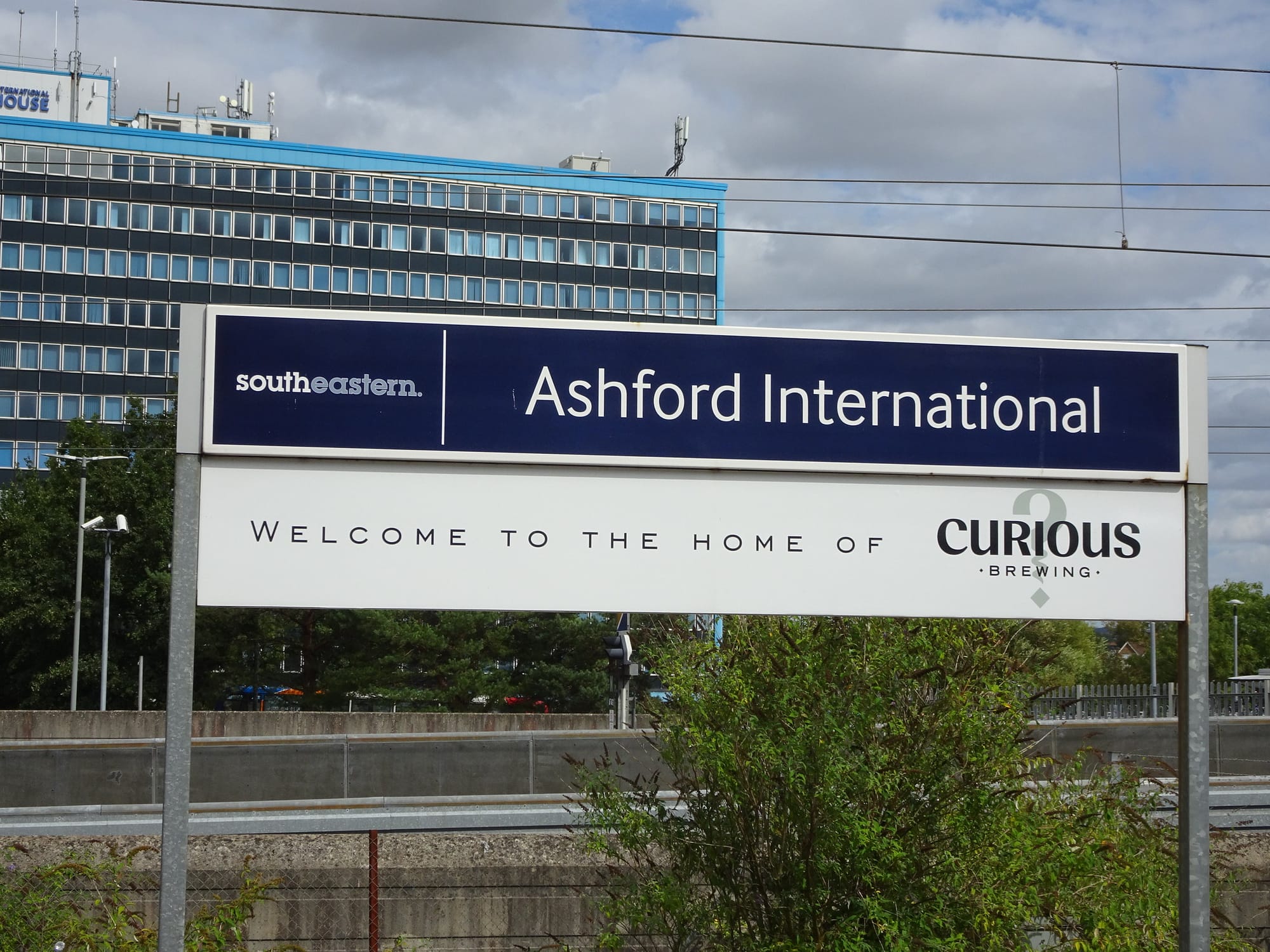
What follows here is an attempt to apply what I learned from my #CrossChannelRail project to one specific, current debate, namely whether any UK stations could be (re-)opened for long distance trains to Continental Europe through the Channel Tunnel. There is a lot more background about this whole topic in the #CrossChannelRail final report I released 12 months ago.
Three stations are talked about: Ashford International (that was served by Eurostar trains between 1996 and 2020), Ebbsfleet International (served between 2007 and 2020), and Stratford International (never served by any regular international train service).
Stratford is the one in the headlines currently, and I have addressed some of the specificities of that station in a separate post. However I am going to try to cover all three UK interim stations systematically in this piece. Some of the lessons could apply to Calais-Fréthun, but I am not going to cover that station here.
First, what does a station need?
A means for passengers' luggage to be scanned, and their passports to be checked, when departing the UK towards Continental Europe, and some secured place (a terminal) where passengers can then wait until they can board their train. And a couple of platforms - for departing and arriving trains - are obviously needed too. And all of this is subject to the legal framework currently in place, and I am not counting on that framework changing.
On the equipment points the three stations vary.
Ashford and Ebbsfleet have more or less complete facilities already - the bag scan machines have been removed since 2020, but the terminals are otherwise in working order. But the terminal at Stratford was never equipped - it is an empty shell. When the Mayor of London talks about his plans to open Stratford costing £20 million, my assumption is this is the cost to equip the terminal. All stations would additionally need to be equipped with Schengen Entry/Exit System (EES) terminals.
Overall though, while the costs to equip Stratford are higher, we know how it would be done - the Mayor of London has a plan to sort it out. At Ashford or Ebbsfleet the costs are lower, but we do not know who would bear them.
Second, who pays to keep the stations running?
Not only do the stations have to be equipped, but they also need to be operated and, most importantly, staffed. And with bags to be scanned and passports to be controlled, the costs of this are not small.
We discovered this week that Eurostar has been covering the entire cost of the passport controls at Rotterdam and Amsterdam on its Netherlands route (good work Dutch passenger organisation Rover for highlighting this!) while by contrast the Dutch government covers these costs for flight passengers at Schiphol Airport. And Eurostar covering these costs means passengers pay more for their tickets. In Netherlands of only this border control aspect total €6 million a year.
At present we know neither the annual cost of operating any of the three UK stations, nor who would foot these costs.
Third, how many passengers are going to use these stations anyway?
Eurostar's argument for not re-opening Ashford and Ebbsfleet was that the costs of stopping there (read: costs of keeping the terminals running) were higher than the profit the company would make from the limited number of extra passengers they would transport from doing so.
This then leads us to the complicated issue of pitting stations against each other. The problems for Ashford really began when Ebbsfleet opened in 2007, as this increased terminal operational costs and splitting passengers between the two rendered both borderline unviable. Passengers numbers at Ashford pre-2007 were solid.
I have previously argued that only one of Ashford and Ebbsfleet should be re-opened, and that should be Ashford, and I see no reason why the current debate about Stratford invalidates that way of thinking - a rigorous assessment of which station would make most sense overall is needed, rather than each station and its political backers making their own case for their own station.
Putting it another way, opening one station the right way must be economically viable. Whether two or three are viable we do not yet know.
Fourth, what operators would want to stop at interim stations anyway?
Not only does Eurostar see no financial gain to stopping at Ashford or Ebbsfleet (let alone Stratford, quelle horreur!) but lacks the imagination to understand why anyone would possibly want to go to anywhere other than the centre of the biggest of big cities. Hell, even Lille is a push for Eurostar. So do not count on Eurostar here.
The attitude of Eurostar's potential rivals might be different though. Virgin could see the advantage of stopping at at least one interim station as a means to serve a different clientele to Eurostar's, and news reports indicate the company has been talking to the Mayor of London about Stratford. Trenitalia has in the past sounded favourable about serving the Kent stations, and likewise might see this a means to differentiate themselves. Gemini was the keenest of all, proposing to even terminate trains at Stratford rather than St Pancras, but their lack of maintenance facilities mean the company is unlikely to get to the starting line at the moment.
Fifth, can other stops help with the St Pancras capacity problem?
As anyone who has travelled through it can confirm, the Eurostar terminal at St Pancras is cramped and overcrowded. While HS1 Ltd is planning to re-build the terminal to up the passenger throughput, anything that would reduce the passenger pressure on St Pancras could also be beneficial.
The problem is that the terminals at Stratford and Ebbsfleet hold only about 250 people each (although Gemini reckoned it had found a solution for more at Stratford, but I am not privy to how exactly they proposed to do this), while the Ashford terminal (capacity: 800) is far larger. A Eurostar e320 seats 900 passengers. Helpful, but not a panacea.
Sixth, is there anything else that could be done?
Ashford, Ebbsfleet, Stratford and even St Pancras are served by national Javelin high speed services, and Southern - the operator of these services - is being rolled into Great British Railways in 2027. So whatever station(s) that were not (re-)opened for international services could be connected with a "Tunnel+" ticket - a kind of national add-on to a long distance cross channel ticket. So for example a Paris - Ebbsfleet journey would be Paris - Ashford, and Ashford - Ebbsfleet on a Javelin train, with guaranteed connections and passenger rights.
So then, what's the answer?
Were I advising Heidi Alexander about all of this, I would prioritise Ashford over the two other stations, and find a way for a combination of central and local government to foot the costs of re-opening the station there and cover the costs of staffing bag scan and passport control facilities for a three year period (that starts when the first services run). Were more than one operator to stop at Ashford, each of them would get their "free" three years, and at the end of that period a negotiation would happen between operator(s) and government to determine whether an operator could bear further costs.
Both Ebbsfleet and Stratford would be offered a "Tunnel+" ticket solution, whereby it would be financially more viable for passengers from both to go to Ashford to board a train to Continental Europe than to St Pancras.
And if Stratford is to open, then that needs to be done thoroughly, with a properly designed, large terminal, so as to really take the pressure off St Pancras. Even some investigation of whether terminating trains at Stratford would be possible (the track layout currently mitigates against this) would be useful as well.
Photo Rights
Ashford International - Hugh Llewelyn - September 4, 2020 - CC BY-SA 2.0