A tram-train for Nijmegen - Kleve: the option with the fewest downsides

In the Newsletter this week
Analysis: The solution for Nijmegen - Kleve is a tram-train
Bullshit Meter: Monocab as a solution for rural rail lines
Good week: Rail passengers in Lithuania get half price tickets
Bad week: RegioJet pulls out of the Polish long distance rail market
Very bad week: Serious accident at a level crossing in Hauts-de-France
Confusion this week: TER tender in Nouvelle Aquitaine
Hungary - Serbia scandal of the week: Orbán's family supplying sub standard stone for the Hungarian section of the new railway line
Photo of the week: Special train to Bouzonville
Calendar: Freiburg-Colmar Protest Day 26 April
Newsletter 012, Friday 10th April 2026.
Subscriber-only newsletter, sent every Friday at 14:00 CET.
The solution for Nijmegen - Kleve is a tram-train
There are two dismantled railway lines at Germany's borders that get more attention than all the others. One is Freiburg - Breisach - Volgelsheim - Colmar (OpenRailwayMap, more about that one below), and the other is Kleve - Nijmegen (OpenRailwayMap).
In both cases the need is obvious - there are enough people on both sides of the border to justify a train connection. And in both cases there used to be a rail connection.
But in both cases the practical problems seem hard to overcome.
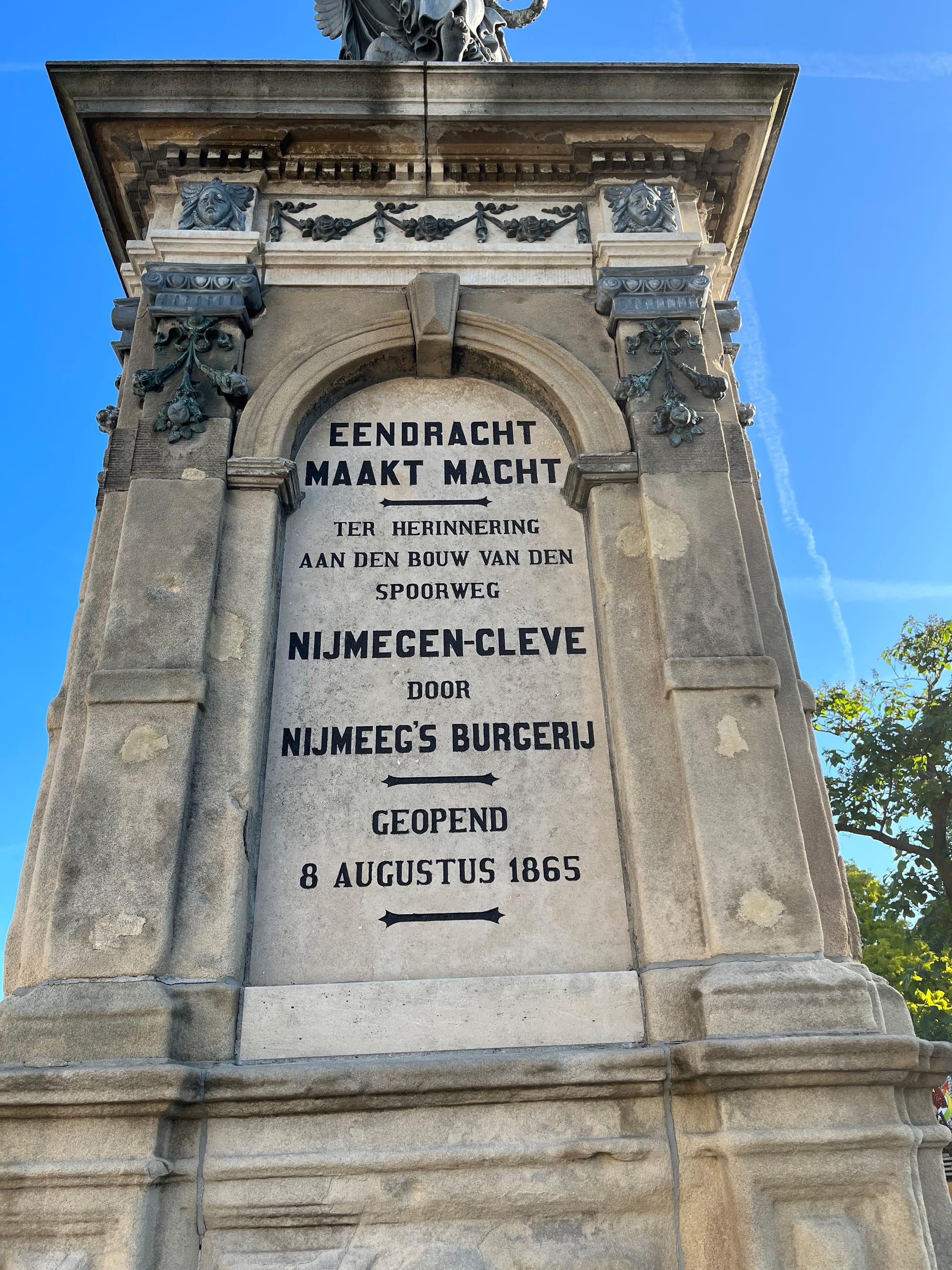
When, on a sunny summer morning during my first #CrossBorderRail tour 2022 I passed the Spoorwegmonument in Nijmegen and headed towards the border on my folding bike, I did not quite know what to expect.
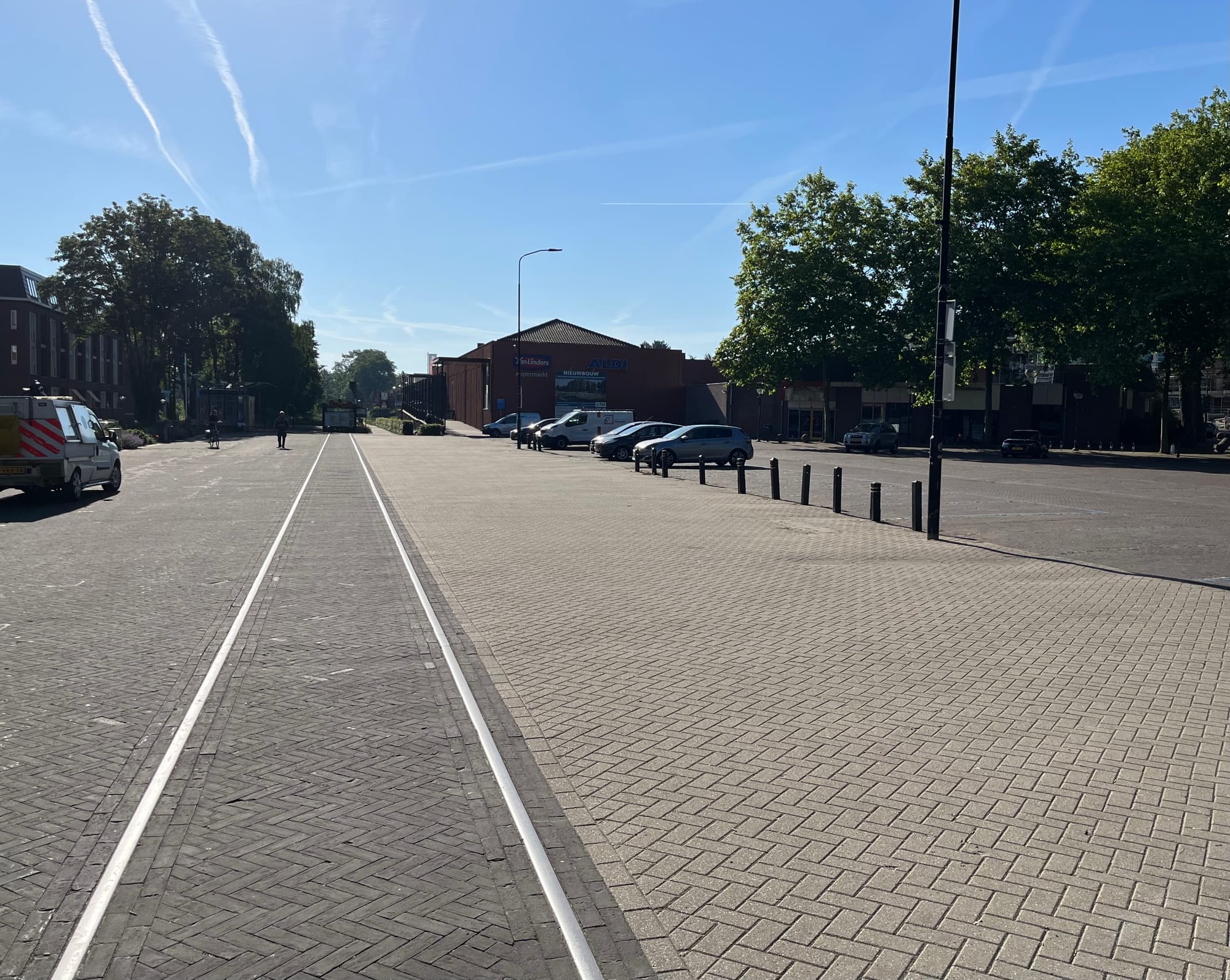
But there after a few kilometres, the problem is clear to see in Groesbeek - the last town on the Dutch side. The railway line runs through what is a sort of square in the middle of the town:
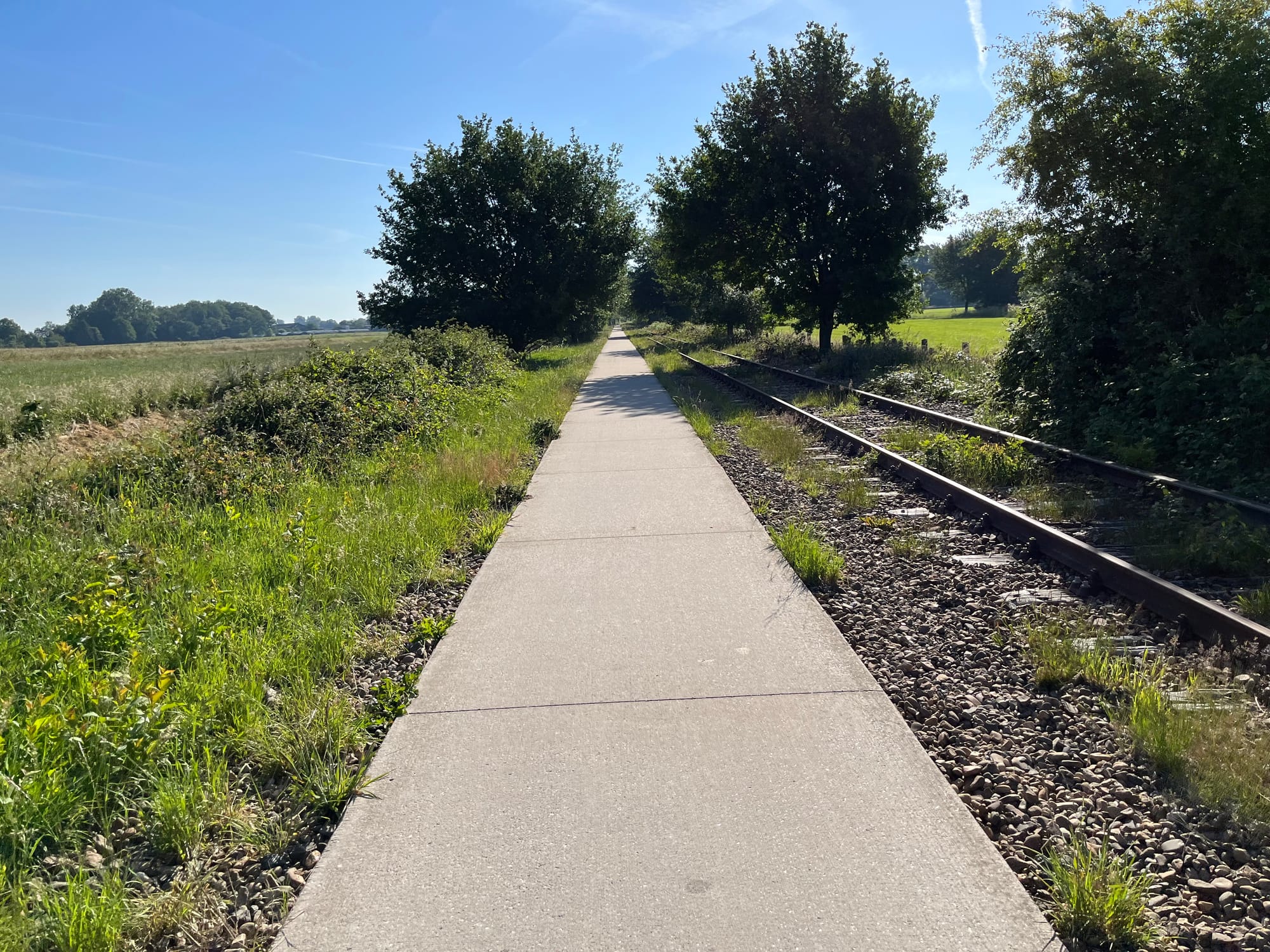
Either side of the square it looks like this, with the old railway running alongside a cycle path. You can also hire a draisine to pedal along part of the old rail track.
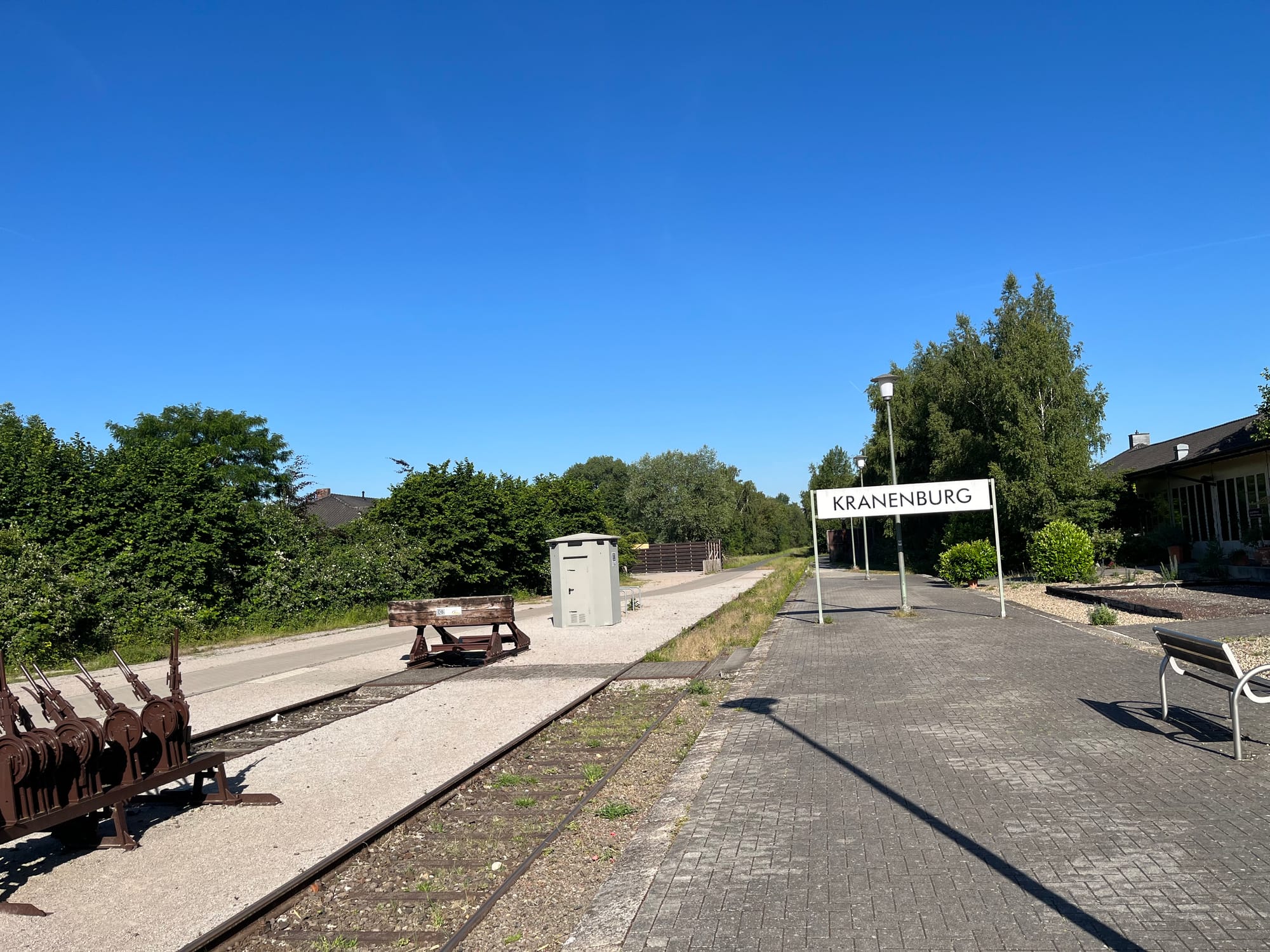
On the German side things are easier - the line is more or less intact, and does not cross the middle of settlements. Before you get to Kleve the line goes through the old Kranenburg station (Kranenburg is the first town on the German side):
Right, so let's get to the politics of this.
First, is there enough demand for some rail solution here?
Nijmegen (population: 189,000) is the regional centre. Groesbeek (18,000) is 9 track-km to the south east. Then comes the border, then 5 track-km further Kranenburg (11,000) and finally 10 track-km further Kleve (53,000). Roughly 24 track-km total. And there is a solid cross border commuter flow, and roads are congested around Nijmegen at peak hours. So there is enough demand to consider it, and honestly were there not a border in the middle this problem would likely have been long solved.
But let's not get carried away here: this connection only makes regional sense.
If you want a long distance rail solution from Dutch big cities to cities in the Ruhr in Germany, then go via Emmerich (OpenRailwayMap) or Venlo (OpenRailwayMap) instead. Given that the existing Kleve - Krefeld line is single track and not electrified, it is going to be neither fast nor convenient for long trips.
As a friend of mine in the region astutely pointed out, there are more people from Kranenburg who are going to want to go to Nijmegen every day than will want to go to Krefeld. So the solution has to be Nijmegen - Kleve, and pretty much just that.
So what do you do? (Screenshot from Mapy.com)
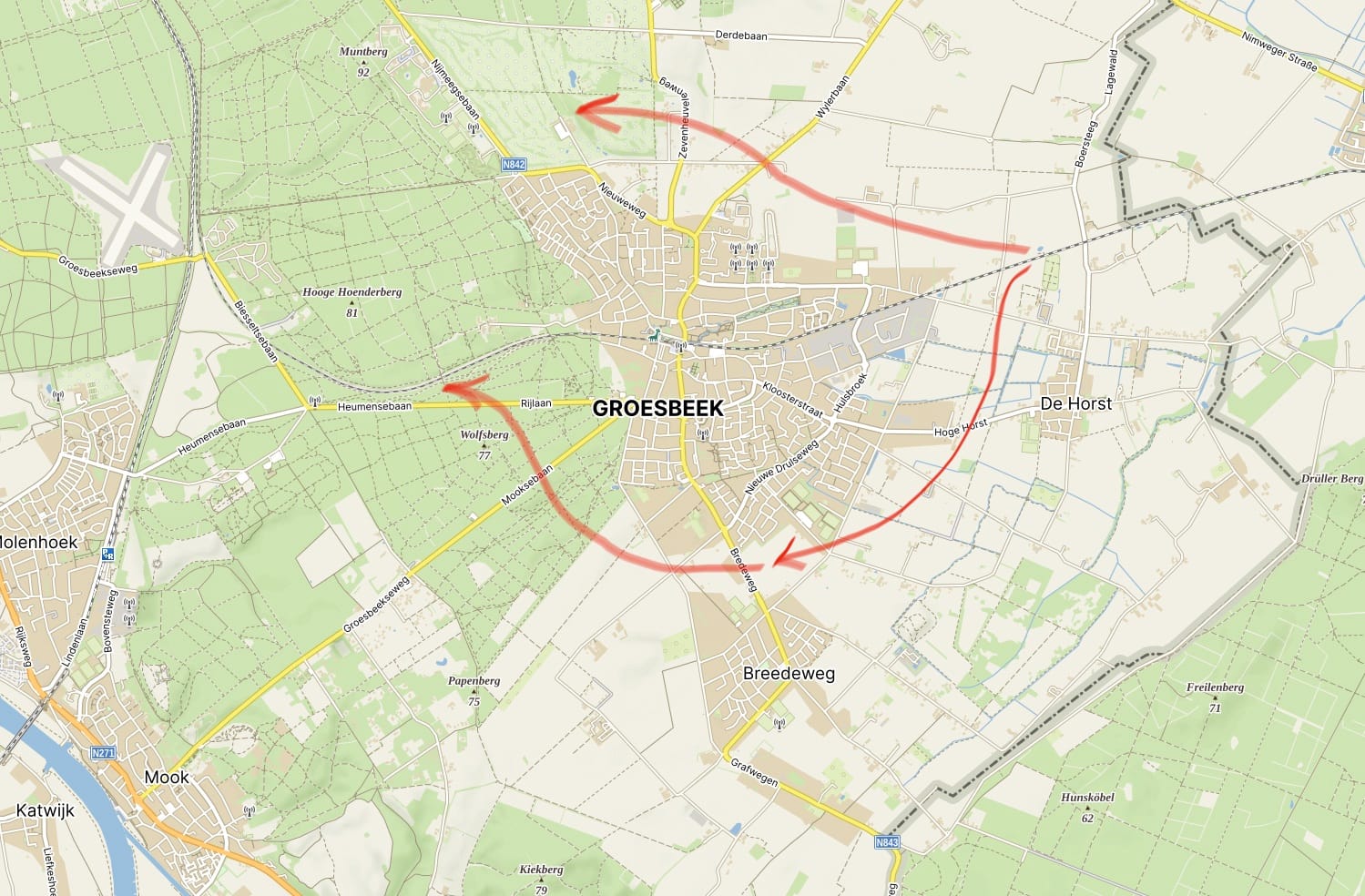
As the map here shows, routing around Groesbeek is no easy task - not least due to the forests and some small hills either side of the town. The northern route looks especially hopeless, and whichever way it is going to be at least into the hundreds of millions of Euro cost.
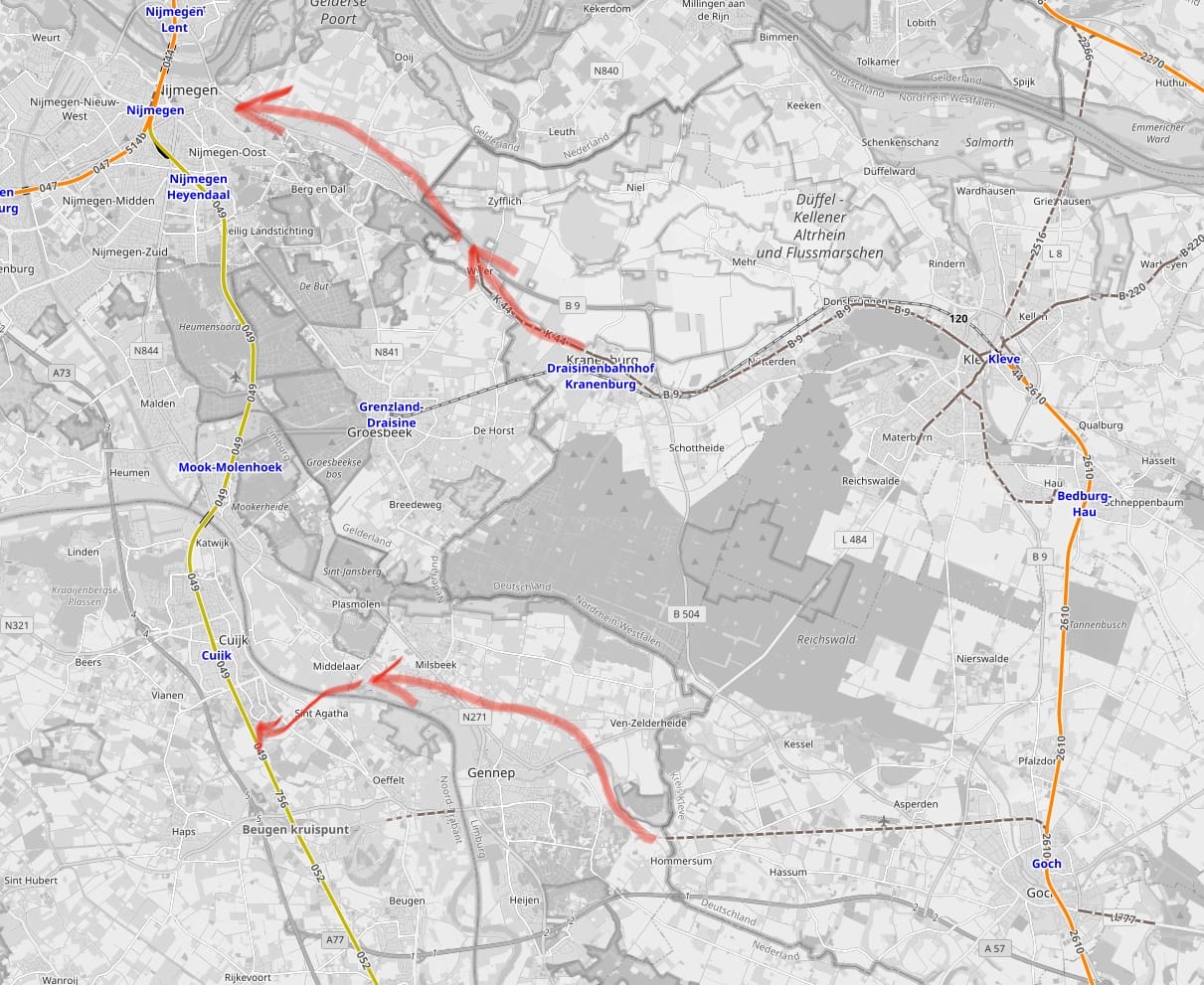
What about ways around the town further south or north? These also look hopeless. Route north from Kranenburg and there is no obvious way into Nijmegen (screenshot from OpenRailwayMap):
And I went to check the southern option this week (hence why I am writing this article now!) - re-using the old Boxteler Bahn route from Goch to Gennep. This is the border at Hommersum:
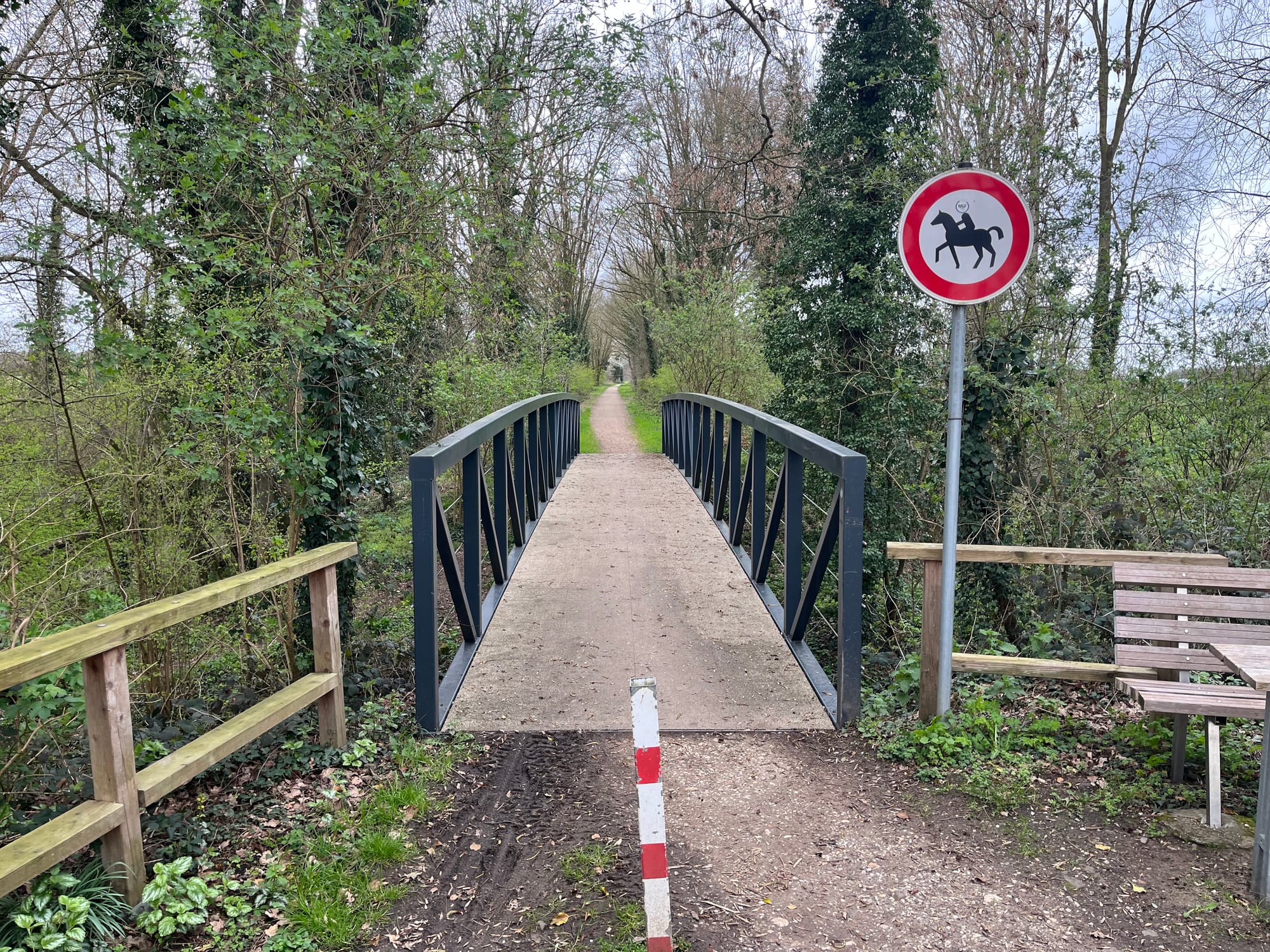
The railway is long gone, and you would need a new alignment, and a new bridge over the Maas as the alignment is blocked by a housing development in Gennep. And doing this would eliminate the main point of the whole thing anyway - to connect Nijmegen and Kleve!
So if you cannot get around Groesbeek, can you get through it somehow?
You could, theoretically, put the railway line in a cut and cover tunnel, but doing that is going to mean years of disruption and huge cost - again hundreds of millions of Euro.
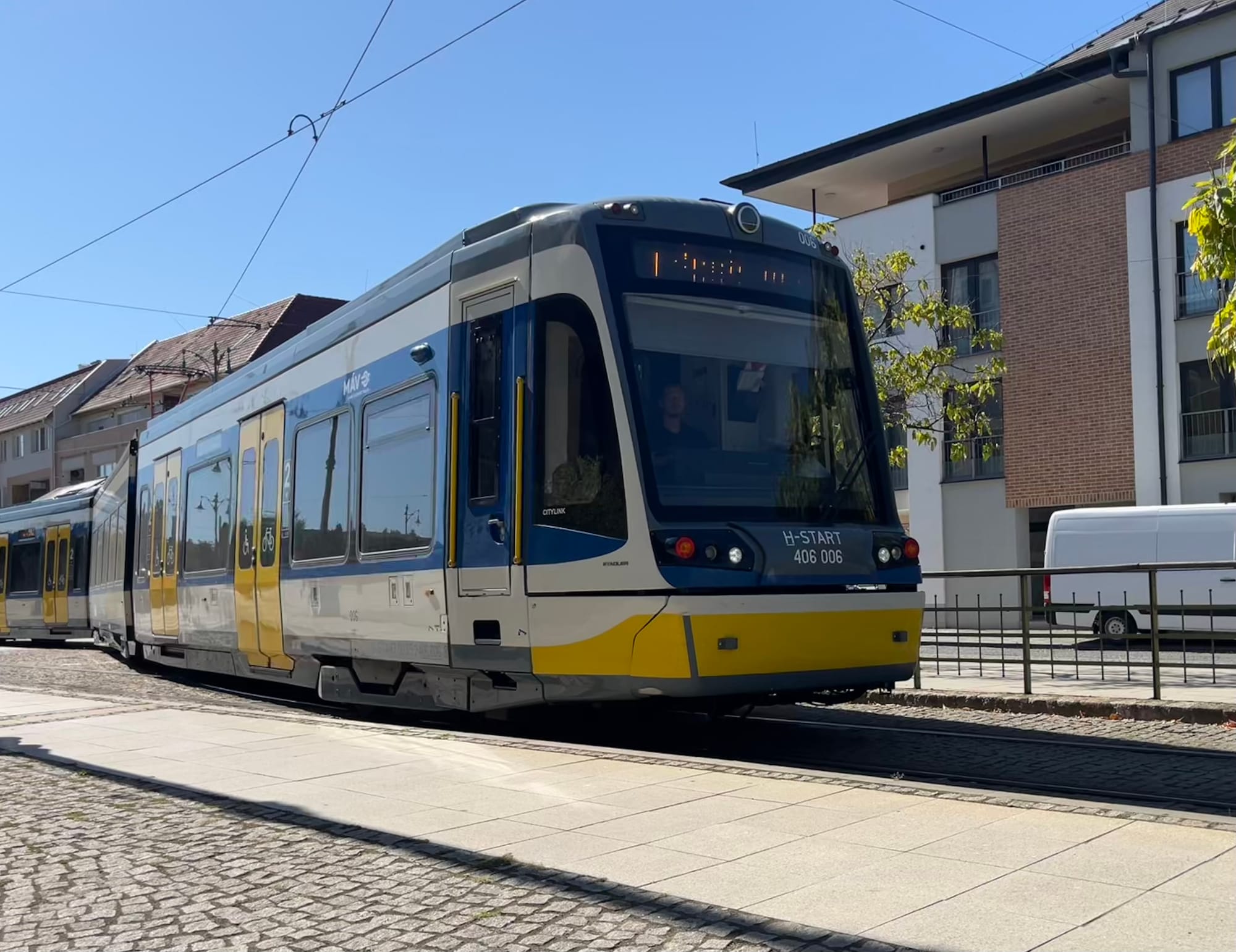
So that leaves us with one workable option: a tram-train.
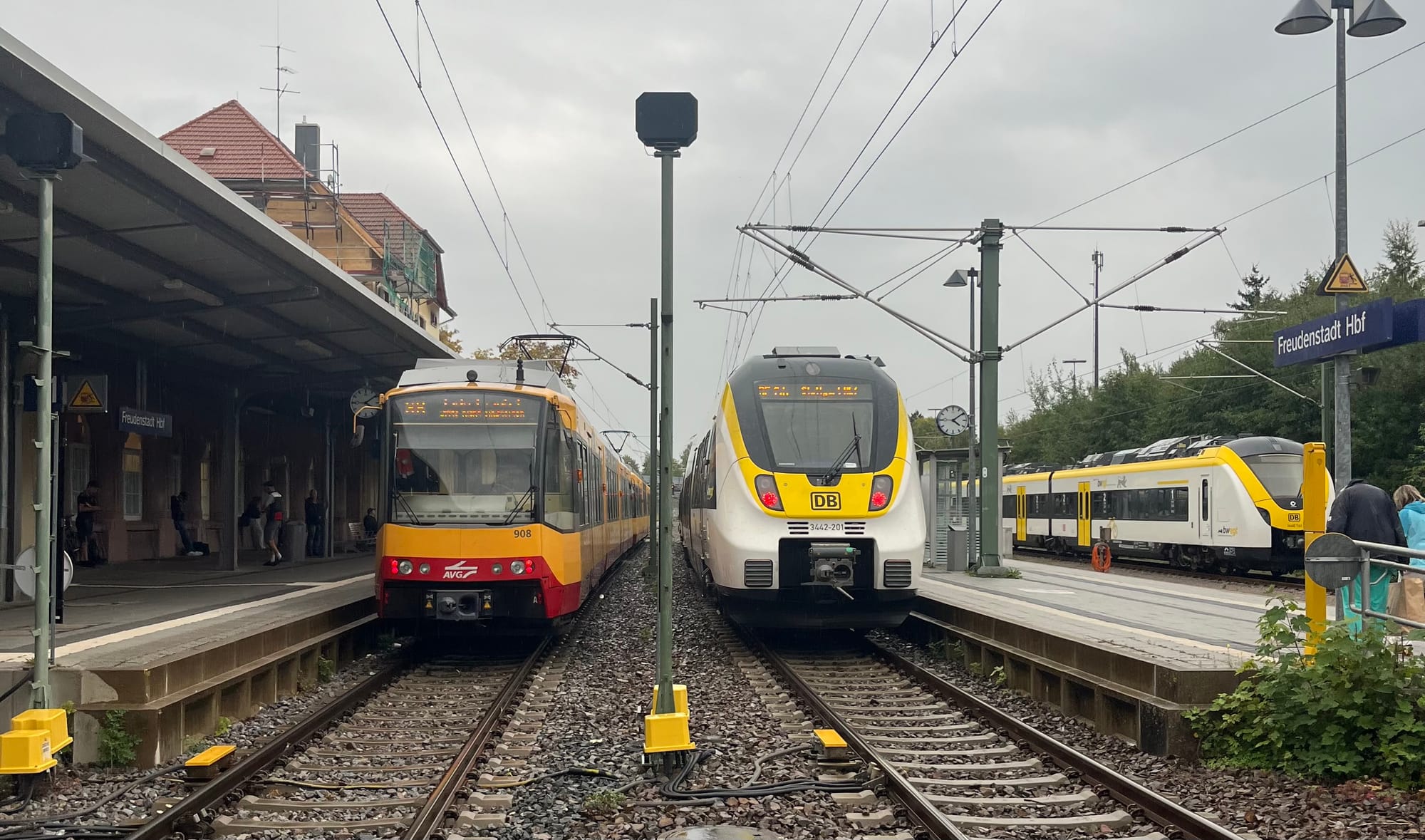
A tram-train can run on regular railway tracks at up to 100km/h, and it can run as a tram (so be mixed with other road traffic) where necessary. De facto for Nijmegen - Kleve this would mean running on the Maaslijn south from Nijmegen to somewhere at the edge of Groesbeek, run as a tram through Groesbeek, as a train again on the cross border section, as a tram through the edge of Kleve, and then end at Kleve station.
With this you could achieve a Nijmegen - Kleve trip time of about 45 minutes - competitive. Given Nijmegen station is electrified, and Kleve is receiving fast charging infrastructure for battery trains, you could even foresee a battery-electric tram train, meaning you could even manage to cross Groesbeek without needing any overhead wires there. Also as the line through Groesbeek would legally be a tram track, not a railway line, freight would not be permitted - meaning no way for noisy freight trains to use the track, keeping the locals happy.
So that's your solution. A battery-electric tram-train is the solution for Nijmegen - Kleve.
Bullshit Meter: Monocab as a solution for rural rail lines
Another week, another Gadgetbahn. This time one from Germany - Monocab. It's supposedly so important there is even a Wikipedia page about it.
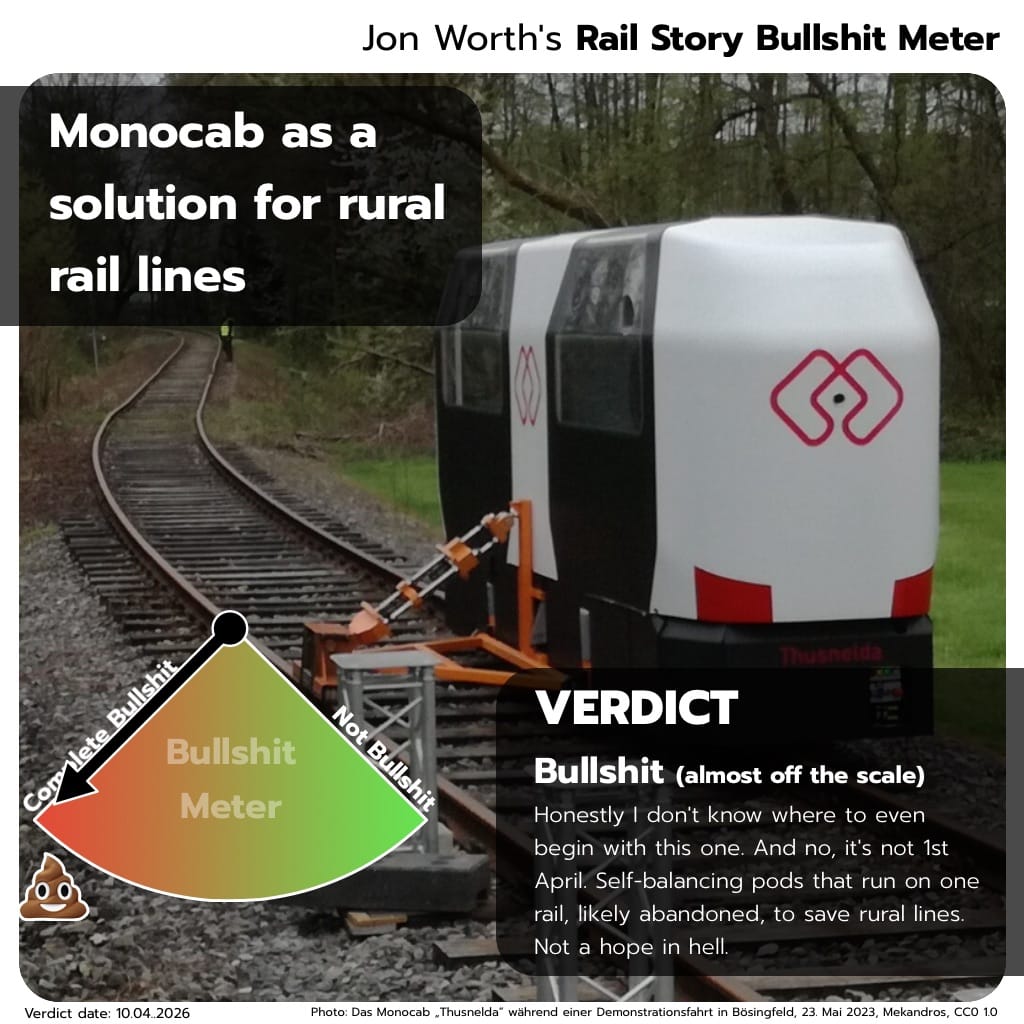
This thing is a narrow monorail that is supposed to balance on a single traditional rail track, and has a gyroscope to keep it upright. There is capacity for half a dozen people inside, and theoretically these cabs can run at up to 70km/h.
Oh and I can just imagine a bunch of teenagers riding these thinking "let's rock it back and forth as much as we can, so we get it to fall over".
But even if you overcome that is that the problem here, just like with other Gadgetbahn ideas I analysed in a previous newsletter, is this is a solution looking for a problem.
Enough passengers? Renovate the track and run a small train.
Not enough passengers? Run a good bus.
What does this low capacity, technically complicated, rail vehicle that you cannot mix with other rail vehicles (as it does not pass regular rail crash worthiness tests) achieve that you cannot achieve with something else? Also to be able to turn these pods around, or get them onto the other rail, you are also going to have to adapt your tracks too - more cost and complexity.
The idea is bullshit. Sorry.
All previous Bullshit Meter posts can be found here.
Good week: Rail passengers in Lithuania get half price tickets
With fuel prices rising, what can railways do to help passengers make the switch from petrol guzzling cars to more environmentally sustainable and less fossil ful dependent trains?
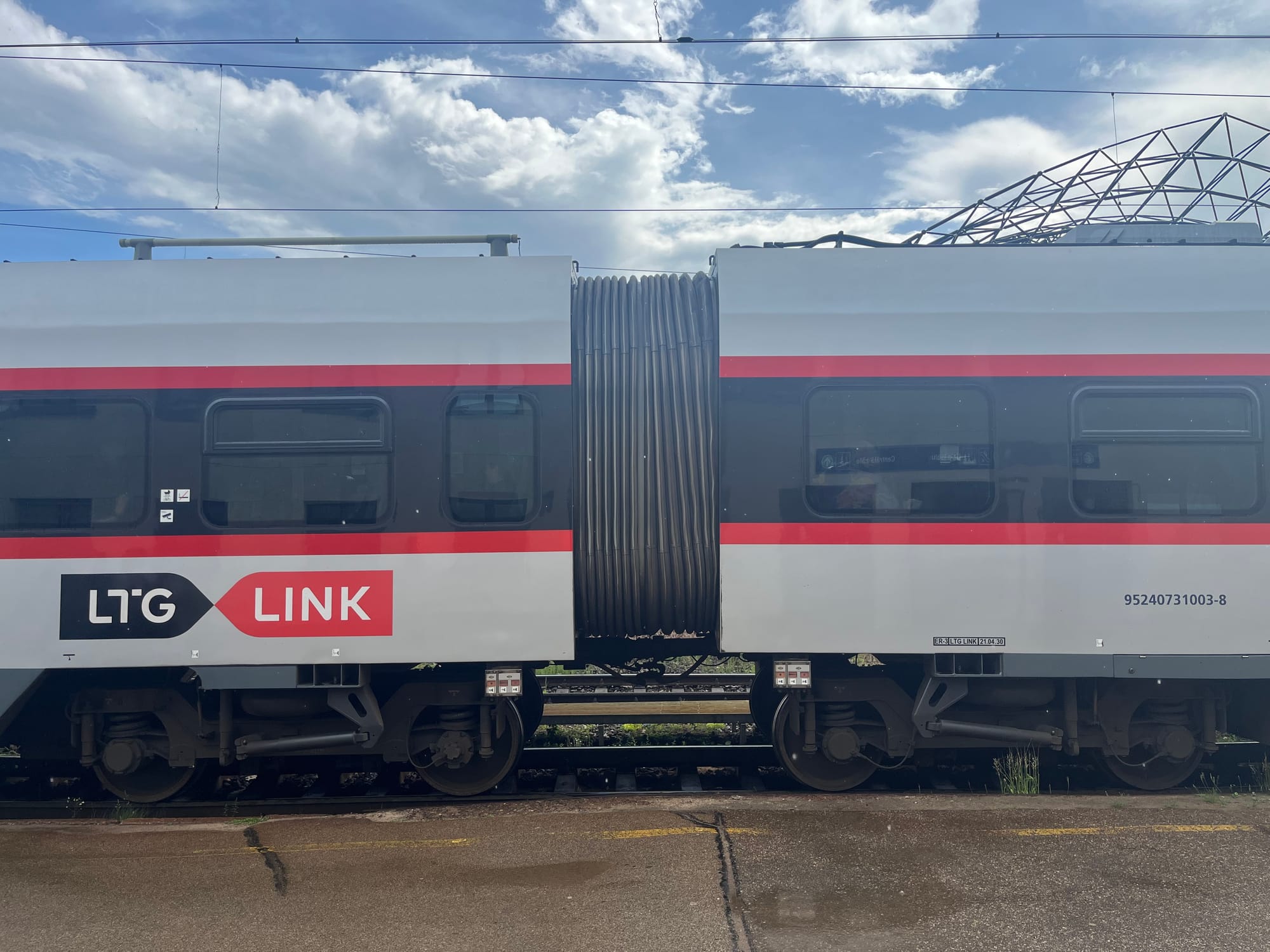
The answer in Lithuania: to halve the price of train tickets.
Meanwhile in Germany a discussion is starting about whether the Deutschlandticket monthly pass could be reduced as well. The boss of HVV is in favour of doing so, and the very existence of the pass is rooted in the response to the petrol price spike of 2022 at the start of the Ukraine conflict.
We are a long way from a coherent response from the railway sector though!
Bad week: RegioJet pulls out of the Polish long distance rail market
18 September 2025 RegioJet entered the Polish long distance railway market. And 3 May 2026 it will all be over - the company is quitting. It's worth reading the whole piece about it from Zdopravy that presents RegioJet's take on it, and this from Kurier Kolejowy that gives PKP IC's side.
RegioJet paints a picture of barriers being put in their way throughout, and malevolent behaviour towards them from other parts of the Polish railway system. But I am not sure that is the whole truth - launching the service before depot access was secured for example looks like a dangerous operational choice, so it strikes me that RegioJet also underestimated the scale of the challenges here.
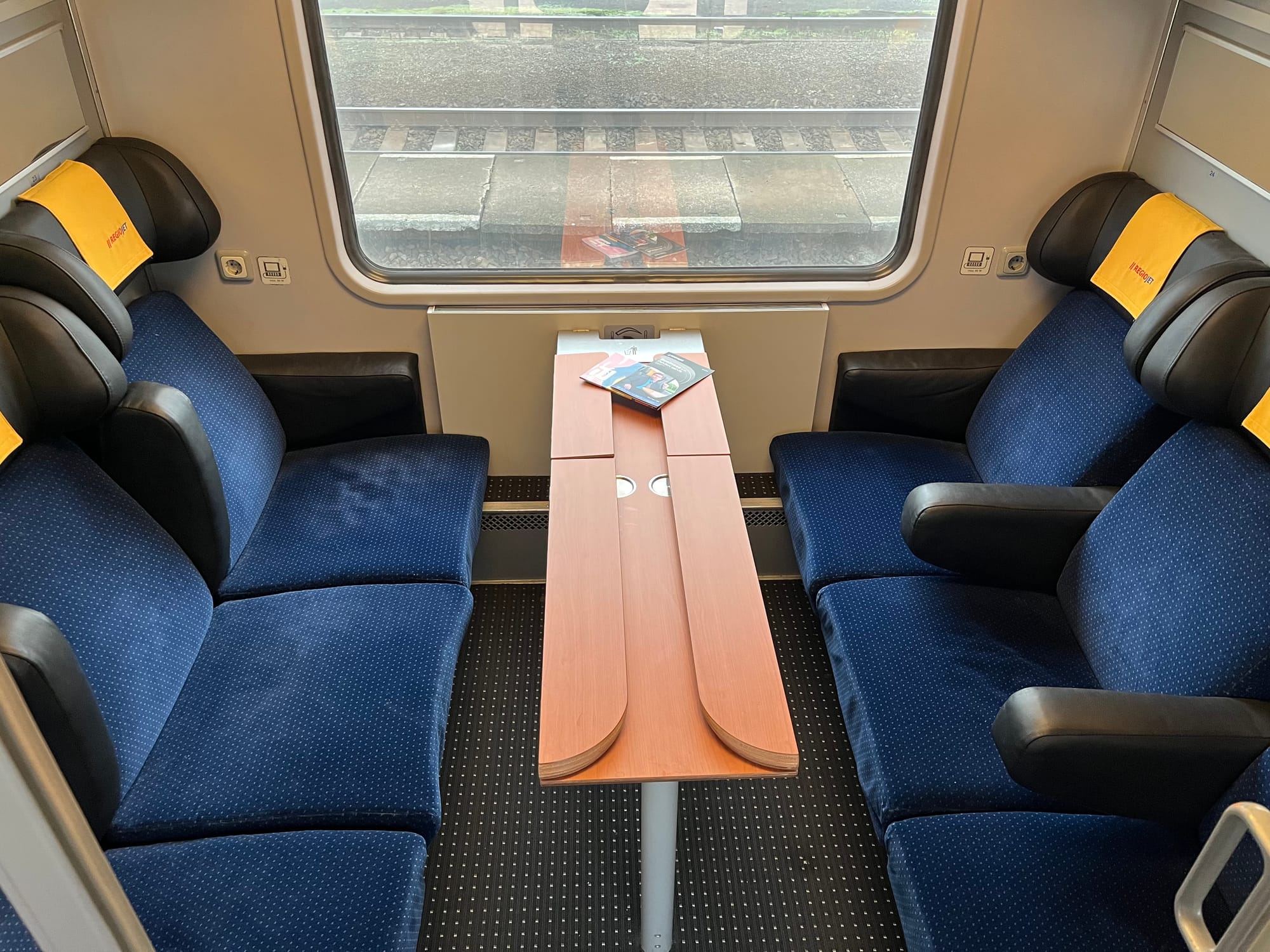
Whether you think RegioJet should enter the market here or not isn't the central question. The issue is in whose interest is the railway run? If PKP IC is to be the sole operator, then it has to be appropriately politically controlled, and set fares at whatever level is considered socially just. Or if competition is the alternative as a means to drive down ticket prices and up the offer, then the rules for that must be set fairly. Having neither one nor the other results in passengers losing out.
Very bad week: Serious accident at a level crossing in Hauts-de-France
A driver of a TGV was killed this week when his TGV hit a truck carrying military equipment near a Lens in northern France. The collision was on a old line that TGVs use for part of their route - level crossings are generally not allowed anywhere speeds are higher than 160km/h (the line where the accident happened is rated for 140km/h), but even below that crashes can be deadly.
As someone who follows railway news from across Europe, incidents at level crossings are common, and often cause deaths, but much more often they are deadly for the people in road vehicles rather than people in the trains. A train weighing a few hundred tonnes generally obliterates the road vehicle that weighs much less. The incident this week is a counter case.
The only way to eliminate accidents like this is to eliminate level crossings - but that needs costly bridges or underpasses, and even finding space to build those in densely populated urban areas is hard.
A horrible incident, but the fundamental problem is not going away.
Confusion this week: TER tender in Nouvelle Aquitaine
It was heavily rumoured that Transdev had won a tender to operate 7 TER lines in Nouvelle Aquitaine, and then, suddenly, SNCF Voyageurs was announced as the winner.
SNCF, according to BFM, submitted two different offers, and according to Mobily-Cités new SNCF boss and ex-Prime Minister Jean Castex followed the process very closely.
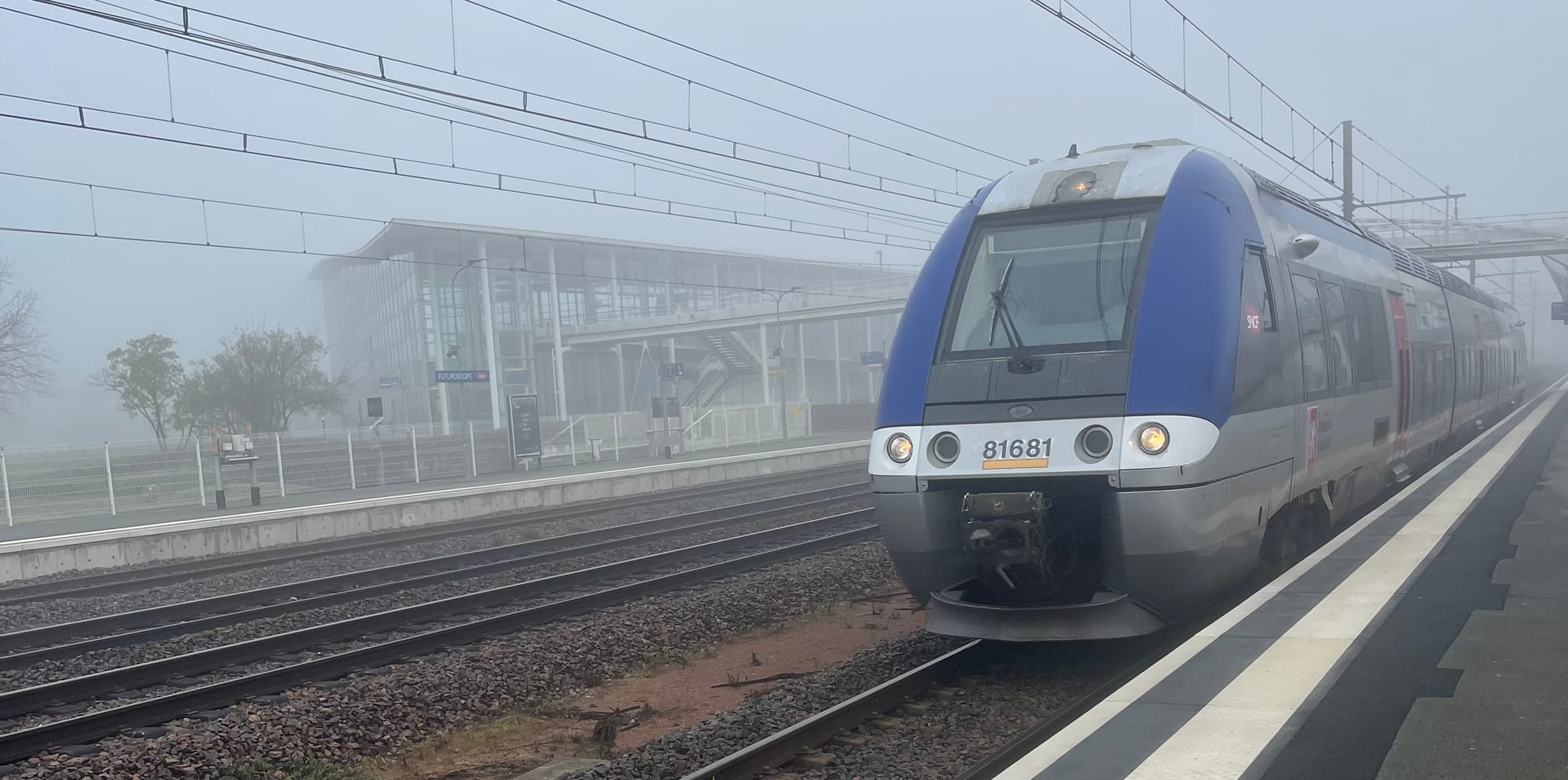
Now whatever you think about tendering services like this, I am pretty sure this is not how it is supposed to work. Each party is to submit its bids, and then a decision is to be made according to the stipulated criteria. And there should be a paper trail to establish what was submitted, when, and by whom. SNCF should not be submitting a second bid once it knows what Transdev has sent in.
Will Transdev challenge all of this in court I wonder?
Hungary - Serbia scandal of the week: Orbán's family supplying sub standard stone for the Hungarian section of the new railway line
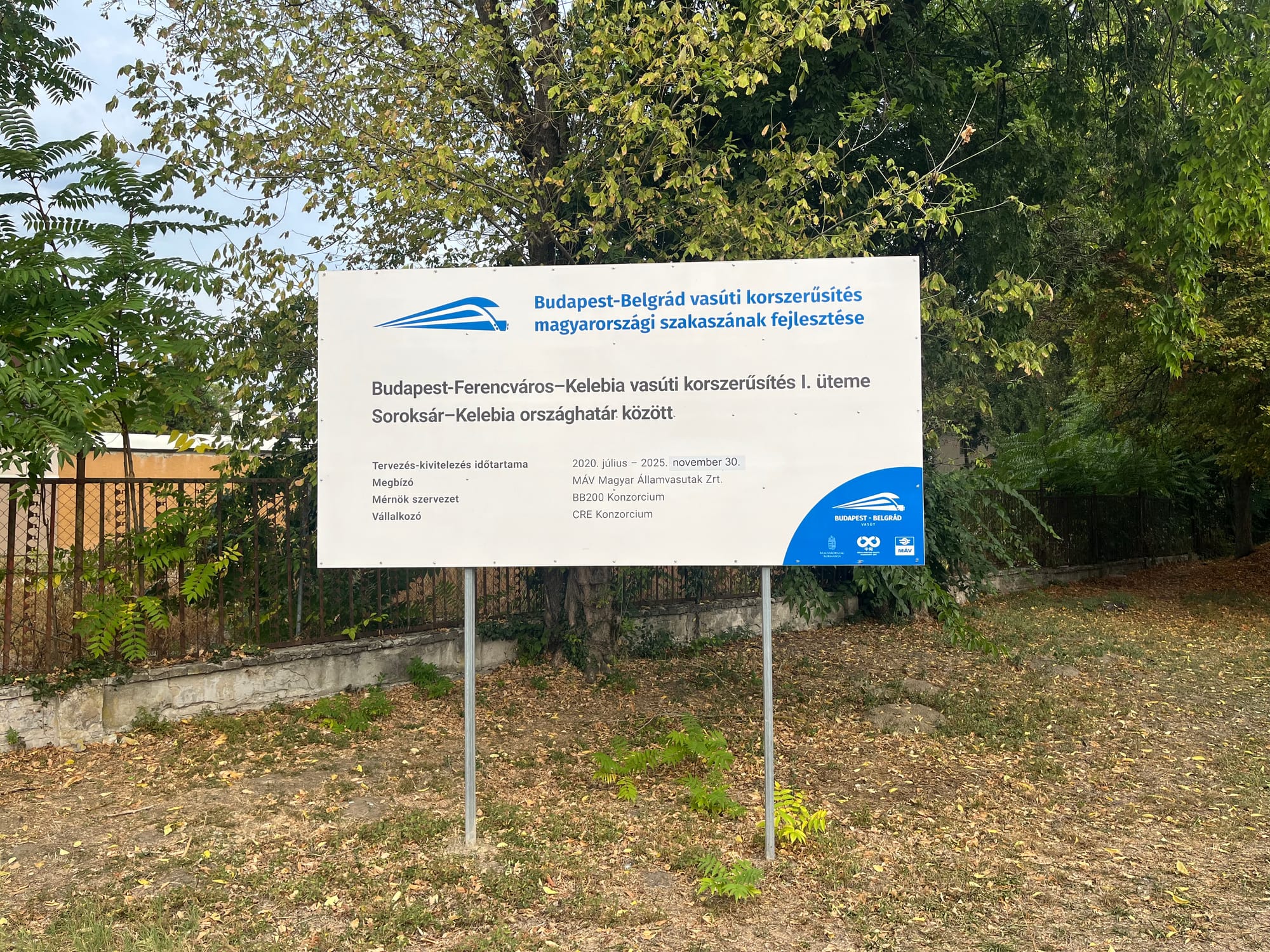
Another week, another scandal for the problematic Budapest - Beograd line. In last week's newsletter the news that the line will not open before the Hungarian Parliamentary Election on 12th April. This week the news from 444.hu that mining company owned by Viktor Orbán’s family, Dolomit Ltd., supplied sub standard stone for the construction.
Dolomit Ltd., which generates revenue in the billions of forints, is majority-owned by Orbán’s father, Győző Orbán Sr. Orbán’s younger brother, Győző Orbán Jr., works at the company as managing director, along with his other son Dávid Orbán.
Let's hope the stone is not for anything critical for the line. Then we might have a situation like on the Serbian side.
Photo of the week: Special train to Bouzonville
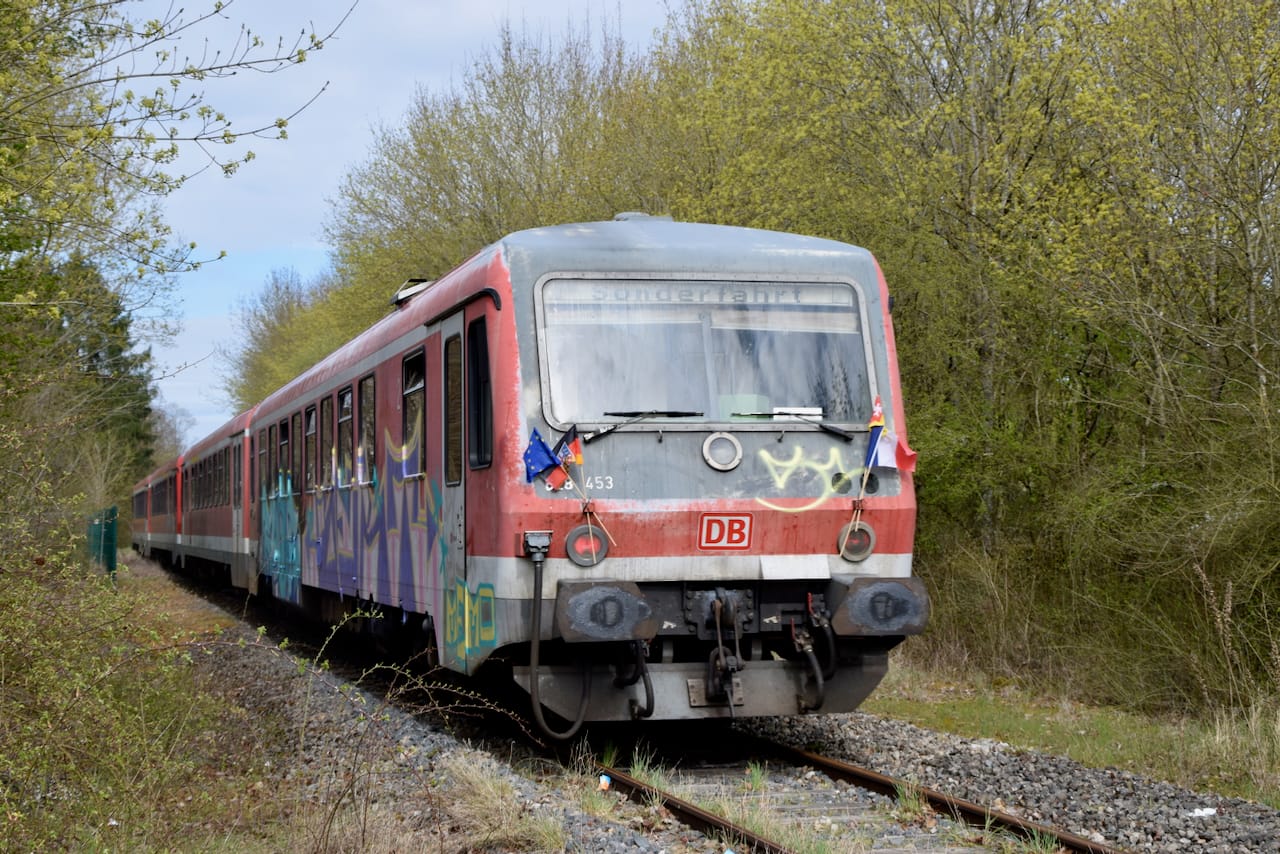
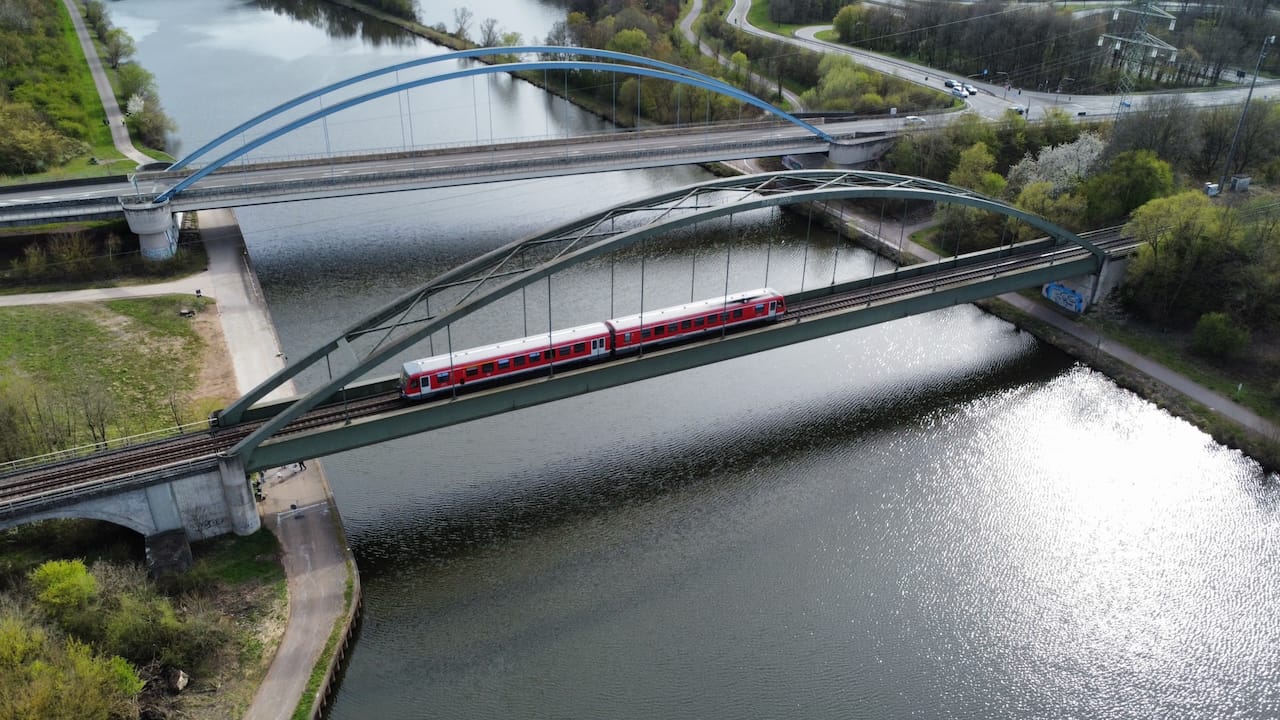
In last week's newsletter I wrote about train services between Saarland and France, and so the pictures this week are of the special train between Dillingen (Saar) and Bouzonville that runs only one day a year, on Good Friday.
Calendar: Freiburg-Colmar Protest Day 26 April
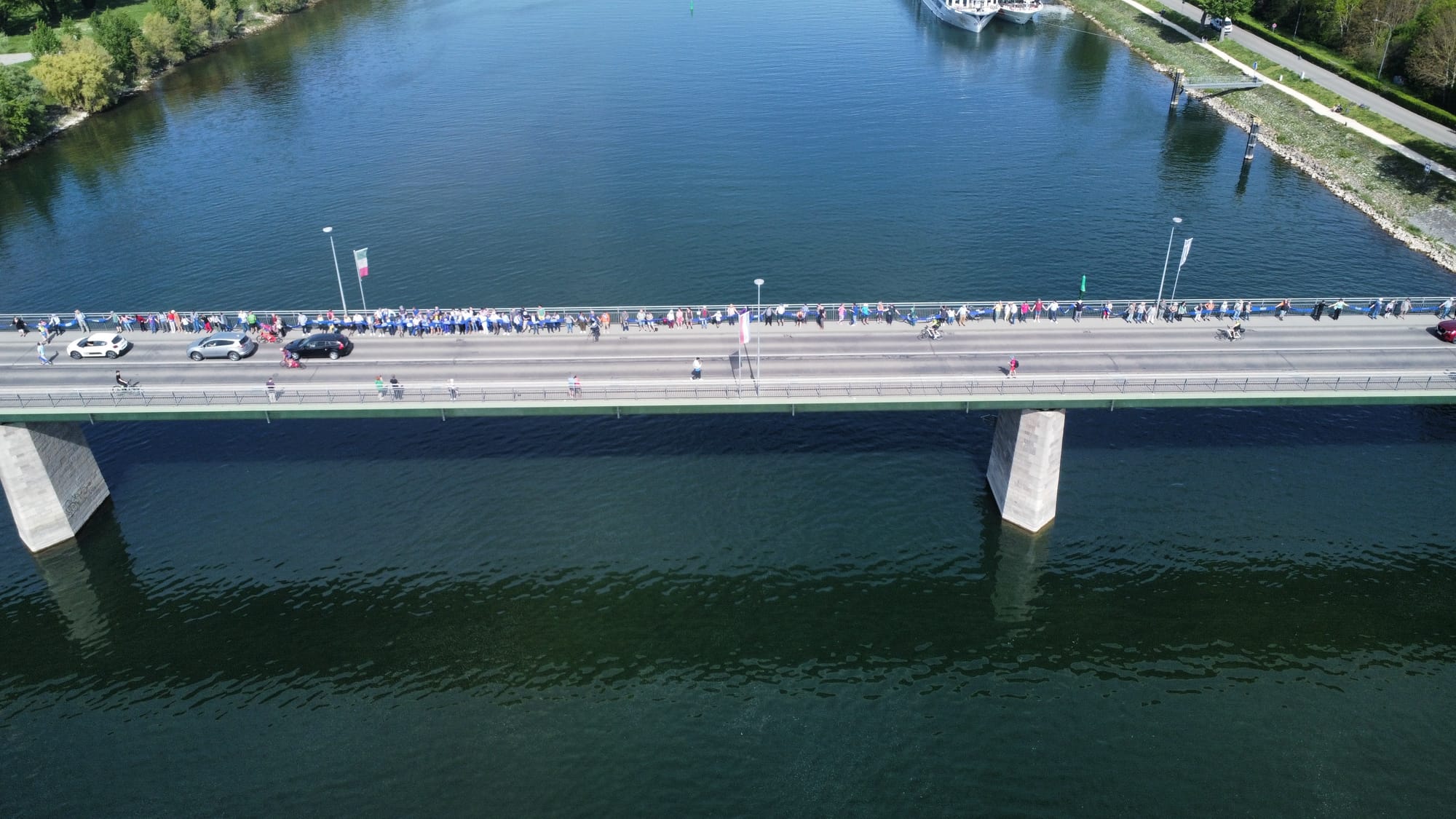
Back in 2024 I went to Breisach for the day of action for the re-opening of the Freiburg - Breisach - Volgelsheim - Colmar cross border line. This year there is a further day of action, 26th April in Volgelsheim - more info here.
I can't go there this year (I am in Beograd, Serbia that day) but do go along if you can!
If you would like to stay up to date with what I am doing, there are public calendars to which you can subscribe: Jon Worth - Speeches and Events ICS | Jon Worth - Travel ICS | Jon Worth - Other Rail Dates ICS And if you'd like me to speak at an event or run a workshop, contact me about that.
Photo Rights
All photos in this edition are taken by Jon Worth. Bullshit Meter images always have photo rights listed directly on the image.