Italo in Germany. Nice idea, but many open questions.

In the Newsletter this week
Analysis: Italo in Germany. Nice idea, but many open questions.
Bullshit Meter: Leo Express Przemyśl - Frankfurt train to start in 2026
Good week: Czechia and Poland are serious about building a narrow gauge cross border rail line
Also a good week: TGV-M approved by the EU Agency for Railways for operation in France
Very bad week: Fatal accidents at a level crossings in Belgium and Poland
Photo of the week: The beach at Hel
Calendar: Open Transport Community Conference Bern 6-9 October
Newsletter 019, Friday 29th May 2026.
Subscriber-only newsletter, sent every Friday at 14:00 CET.
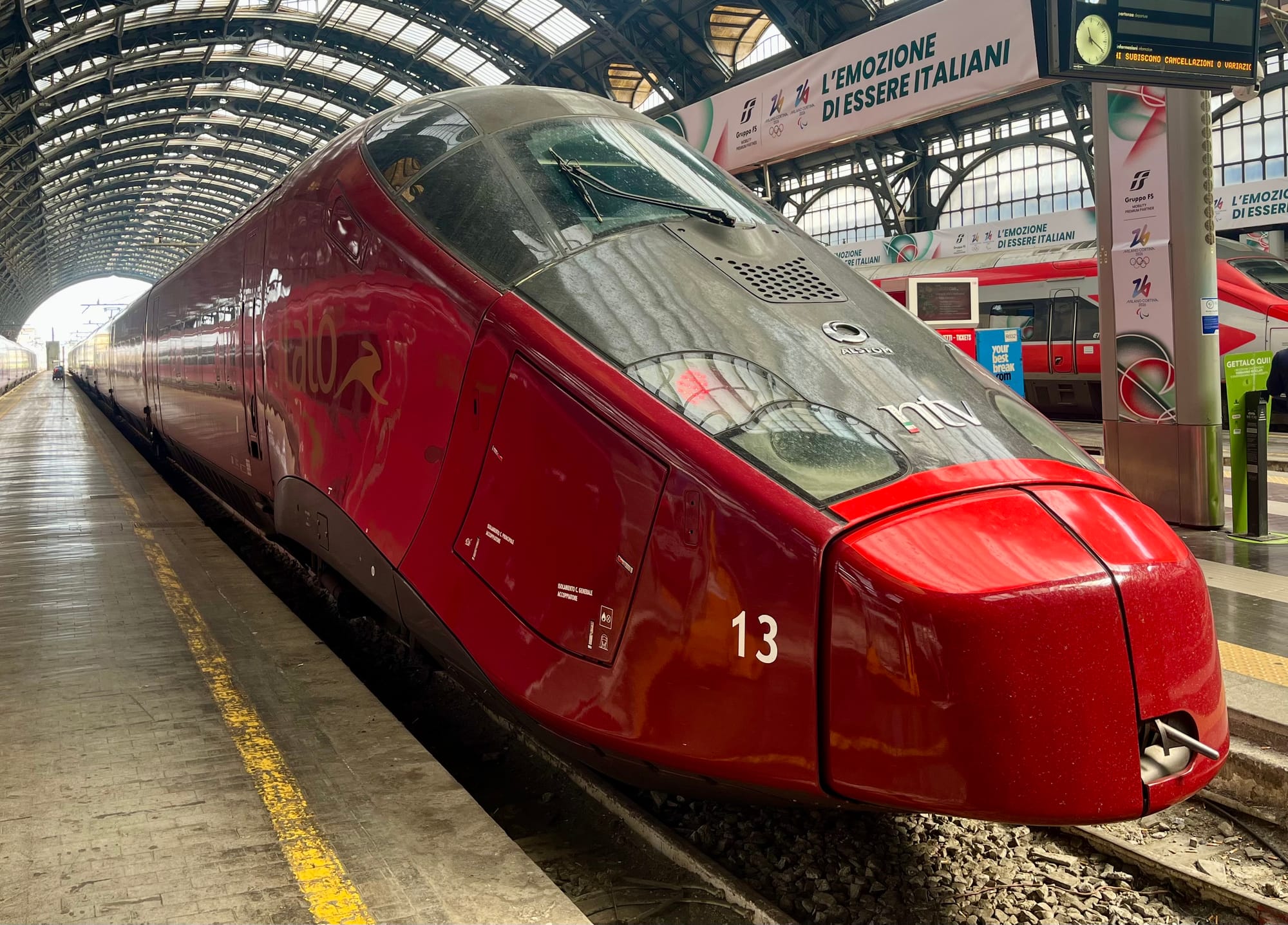
Italo in Germany. Nice idea, but many open questions.
When, back in April, Stuttgarter Zeitung broke the news that Italian private rail operator Italo wanted to enter the German market, many were optimistic. The progress in the decade since Italo entered the Italian market was impressive, so what would not be welcome about them trying to do the same in Germany?
At the macro level, were Italo to expand, where could they go? France already has Trenitalia and Renfe, and soon also Velvet, competing with SNCF. Spain has Iryo and OUIGO competing with Renfe. Germany, with only the slower, low cost operator Flixtrain competing with Deutsche Bahn, looks like an ideal opportunity.
But those of us with an eye on rail operations had our doubts.
Given the decrepit and overloaded state of Germany's rail network currently, the question on my mind was where could Italo even run reliably? Italo at the outset says it wants to run Köln - Frankfurt (Main) - München hourly, but Köln is about the most congested and unreliable main station in all of Germany. This does not look sensible.
There is, I think, a fundamental misnomer, and it is one that becomes clearer in this FAZ interview with Italo boss Luca di Montezemolo. He paints a picture of Trenitalia being a poor quality and complacent incumbent operator when Italo entered the Italian market in 2012, and hence a leaner, better organised, more service orientated private rival, Italo, could do better than the state incumbent.
But what di Montezemolo fails to mention is the infrastructure. The entire Torino - Milano - Bologna - Firenze - Roma - Napoli high speed corridor, the backbone of Italo's operations even now, was completed in 2009 (background about each section here), before Italo entered. Infrastructure was available, with adequate spare capacity, to allow a new entrant to run reliably.
That is not the case in Germany.

As if that were not enough of a challenge - where could a new operator manage to run reliably - Italo is putting one more requirement on top: it wants medium term guarantees about access to that infrastructure, while DB InfraGo (the network operator) in Germany gives paths in a yearly process. FAZ has more background on this argument here. The Bundesnetzagentur is going to adjudicate on this by mid June - more by Dan Jensen here.
And this demand for multi-year guarantees has annoyed not only InfraGo, but the other private rival to DB, namely Flixtrain, that has managed to get a foothold in the German market with this annual process. Why, Flix logically asks, should Italo be granted something to which we were not entitled? Italo's behaviour has gone so far so as to even annoy Christian Böttger (quoted in Süddeutsche here), and he is normally German media's go to DB critic.
Then we then come to the trains that Italo wants to order.
Rather than extend their relationship with Alstom (that built their initial AGV trains, and has been building post-Pendolino trains for them more recently), Italo wants to go for Siemens Velaro trains in Germany. The company has indicated it would have three comfort classes on board (as in Italy), and I suspect they might not have a dining car - eliminating this, and having some vending machines instead - increases the seating capacity.
But why Siemens not Alstom? Quick delivery (basically Siemens could keep the production line of the ICE3neo for DB running once those are delivered), and the prospect of jobs in Nordrhein-Westfalen in both construction and maintenance of the trains, keep cropping up in Italo's communication. The trains will run in 2028, Italo claims.
In other words: Germany, here's the deal. We, with our deep pockets (Italo is owned by MSC), will give you 26 and possibly as many as 40 new high speed trains, very soon, built in Germany and securing jobs there, without the German state having to finance anything. Just make sure you open all the doors to allow us to enter your market just the way we want it, OK? It is somewhere between confident and threatening, and it is most definitely heavily political.
Will Italo succeed? It's too early to say, and they are even leaving open the option of not entering the German market at all based on the tone of their media statements these days. But it is most definitely the case that the Italian market in 2012 had many more fundamentals in their favour than the late 2020s in Germany do.
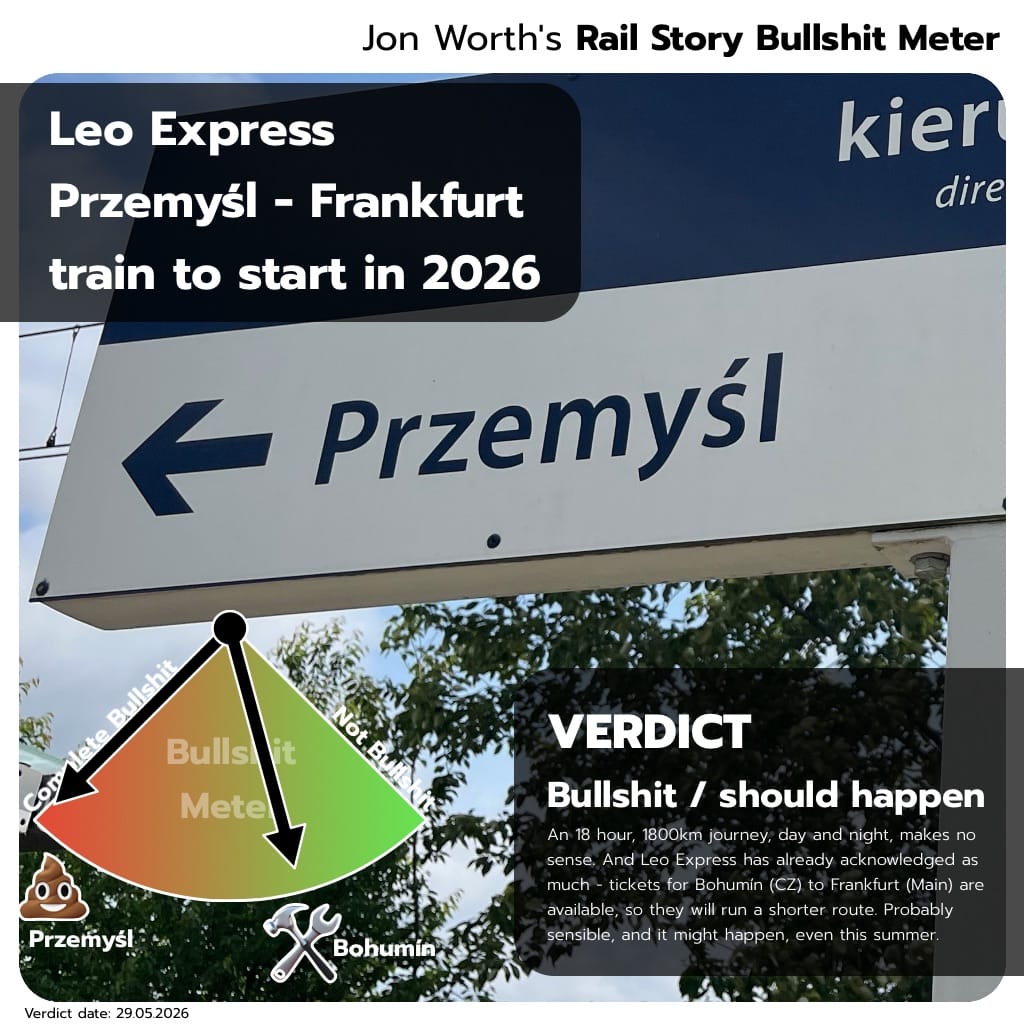
Bullshit Meter: Leo Express Przemyśl - Frankfurt train to start in 2026
1800km! 18 hours! One of Europe's longest scheduled services! Claims Notes from Poland, based on press materials from Leo Express.
Ah.
One problem.
It won't happen, at least not in full.
Look on Leo Express's website and tickets from Przemyśl to Frankfurt (Main) Süd are not available, but Bohumín to Frankfurt (Main) Süd are. Seems Leo Express have themselves realised that an 18 hour long day and night service on busy infrastructure is not a good idea, and cut the service back.
An important issue is - as ever! - rolling stock. Leo has acquired some ex-DB IC1 seating carriages, but has no couchette or sleeping carriages. So if this runs on the curtailed route you're not going to get a particularly good night of sleep. And if Leo's recent experience running Praha - Bratislava / Prešov services is anything to go by, that the service soon collapses due to their incompetence should not be ruled out either.
All previous Bullshit Meter posts can be found here.
Good week: Czechia and Poland are serious about building a narrow gauge cross border rail line

I did not have this one on my radar at all.
Yes, I knew the narrow gauge line between Třemešná ve Slezsku and Osoblaha in northern Czechia ends close to the border with Poland (OpenRailwayMap) but the line has never crossed the border.
But now there are semi serious plans to put that right, as part of wider plans on the Polish side to re-activate the standard gauge railway line Racławice Śląskie – Głubczyce – Racibórz. News from Zdopravy here.
I will add this to the list of places to visit as part of my ongoing #CrossBorderRail project!
Also a good week: TGV-M approved by the EU Agency for Railways for operation in France
More than two years later than planned, there is finally concrete progress getting the new SNCF flagship TGV M series running in France. The EU Agency for Railways has granted its approval for the two voltage version (1.5kV dc, 25kV ac) to operate in France.
Contrary to what was reported by Ville, Rail & Transports, the approval does allow operations at up to 320km/h on high speed lines, but there is a key constraint: "Le nombre de passagers autorisés à bord ne doit pas dépasser le nombre total de places assises disponibles dans le véhicule" - "The number of passengers allowed on board must not exceed the total number of seats available in the vehicle".
That you have to have a reserved seat is normal on existing TGV services, but there is a little flexibility - in cases of disruption some passengers can stay in the buffet car for example. For the moment that will not be possible on the TGV M, although ERA does allow room for that to be changed in future in its approval.
In the end this is just one more constraint that the double deck TGV design imposes. A few months ago in this piece I explained more of the limits.
As for the "news" this week that TGV M will only start commercial operations at the end of the summer, as far as I know this isn't actually a new delay, although I admit by now I have rather lost track of all the delays!

Very bad week: Fatal accidents at a level crossings in Belgium and Poland
Another horrible week for fatalities at level crossings. In Belgium a train hit a school minibus on a level crossing at Buggenhout, and four people in the bus (two adults and two students) were killed, while meanwhile on the train there was not a single injury. In Poland a truck somehow drove into the side of a train at a level crossing near Poznań, and the driver died.
When you follow rail news Europe-wide, you see how often these incidents occur, and how - in the vast, vast majority of cases - it is people in the road vehicles who perish. However engineering out the danger, by replacing level crossings or underpasses, is costly and difficult.
Photo of the week: The beach at Hel
Almost exactly 12 months ago I was on the train to Hel (OpenRailwayMap). And it's an amazing place in the summertime. Do go if you can!

Calendar: Open Transport Community Conference Bern 6-9 October
The previous edition of this conference in Wien in autumn 2025 was one of the best railway events I have attended. In 2026 the event will be hosted by SBB in Bern. There are two parts - hackdays and a conference. You can sign up here! I'll likely be there only for the conference.
Photo Rights
Czech narrow gauge: Phil Richards - Osoblaha 705914 2013 Czech Republic Trip Day Six - May 16, 2013 - CC BY-SA 4.0
Italo Siemens Velaro render - from Italo press materials
All other photos by Jon Worth.
Bullshit Meter images always have photo rights listed directly on the image.