Who is to benefit from the forthcoming reform of the railway ticketing regime in the EU?


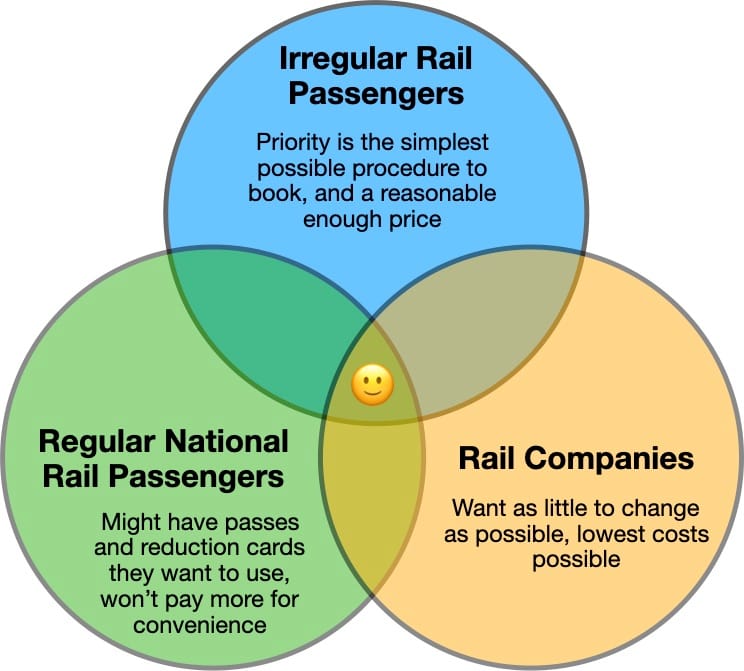
"You are not only a rail expert," a friend wrote to me in response to this blog post about multiple rail tickets. "You are also an expert passenger. You cannot expect the average citizen to know all companies and manually come up with their connections through separate purchases. We need to make it easier to search and buy [rail tickets]."
It is a bit of a straw man argument as I do not expect passengers to have to search for tickets separately, not unless they want to. But the comment is also incomplete, and does not lead us to a workable outcome here. So in this post I will break it down a bit more, and explain what I do want - and why the number of tickets a passenger gets ought not be a problem.
However making it simpler to book train tickets is not the only thing that the forthcoming reform of railway ticketing in the EU (more background here) is going to have to do. Or at least not without caveats.
Because were passengers to be able to decide a way forward here, sure we could impose a strict binding legal framework on the railway companies to sell everything, and be done with it.
But the railway companies - represented by CER and Allrail - are a lot stronger than passengers are with their lobbying. And while they would never really admit it, railway companies are not always very keen on dealing with more passengers.
So the aim is to make booking tickets as simple as possible, within a framework that railway companies can financially and operationally bear.
And even within the pool of potential passengers that could benefit from reforms here, there are differences. What an occasional passenger who might be tempted out of their car or plane wants, is rather different from the needs of a regular national train traveller who would like to use trains more cross-border.
So all of that leads me to the overlapping circles above: we need something good enough for irregular passengers and for regular national passengers, and with costs and obligations low enough to reassure railway companies.
And so that brings us to how to achieve that.
An irregular passenger needs a simple means to find a train connection and to make a purchase. How the price is calculated is going to be less of a concern - they are unlikely to have any passes or loyalty cards, normal tickets will be good enough. So A to B via C booked on one platform in one transaction works well enough for these passengers, if all trains of all operators are available on these platforms. And these passengers need to know they are covered if something goes wrong - so they need passenger rights.
But a solution like that does not work for regular (national) passengers who might have things like Klimaticket or Deutschlandticket, or reduction cards like a Carte Liberté. Either every ticket sales platform, everywhere, would be obliged to recognise every reduction card (huge technical complexity and cost - rail firms are not going to tolerate that), or a passenger might then have different tickets from different platforms for different legs of their trip. And were that the case, what passenger rights would they have?
Putting this another way, were there to be some sort of requirement that all tickets for an entire journey must be purchased together, a regular passenger faces a quandary: pay more to travel with passenger rights, or pay less and face the danger of having to foot the costs of being stranded. Penalising the very people who you need as your core customers.
How then does this look from the operators' point of view?
Operators most definitely do not want the cost that would come with the technical complexity of all having to sell each other's tickets (and remember state owned and private railways in 27 Member States would be included!) and combine them into either single tickets or even single transactions. I cannot imagine the day where any platform can sell every ticket with every loyalty card and every reduction card for every operator on every viable route possible, Europe.
So the outcome that is easiest for the operators is they all maintain their own ticketing systems, and make available their ticketing inventory to third parties that want it on fair terms, and then find a passenger rights solution to apply on top of all of that.
Yes, a passenger rights solution in the case of multiple tickets comes with some cost for operators (as you would need a way for them to assign each other liability), but that cost is going to be a lot lower than complete transformation of their ticketing systems for the initial sale.
Does that work well enough for passengers?
As I see it, yes it does. An irregular passenger can book their international trips on the platform of their choice in one transaction and it is simpler than today, given all operators' data will have to be shared with those platforms on fair terms, and passenger rights will be guaranteed.
And regular passengers who are willing to tolerate some more complexity, and are likely to have passes or reduction cards, will benefit too - because they can travel safe in the knowledge that regardless of how many tickets they have, and how those tickets were booked, they are not going to be left stranded somewhere without passenger rights.
In conclusion: one or more purchase processes, depending on your needs as a passenger - and always with a simple one search, one payment option if you want it. One or more tickets for your journey, depending on what data operators provide. Passenger rights guaranteed in all cases. And a solution easy and cost effective enough to implement, meaning operators should not oppose it.
That's the 🙂 in the middle of the diagram.