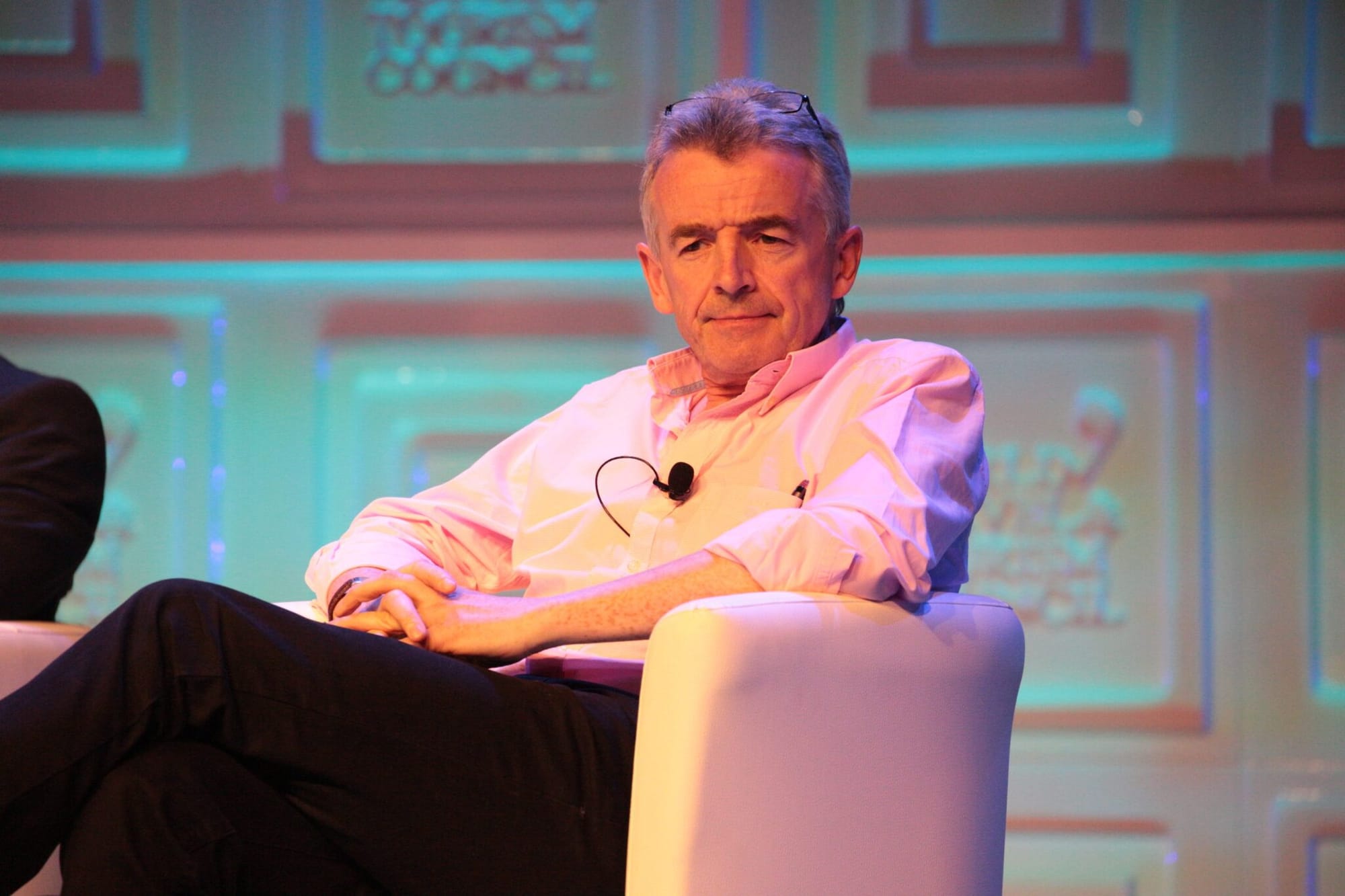
"We can't transport more passengers because our planes are already full" - said Michael O'Leary. Never. So why are rail companies saying essentially that?

It's a pretty obvious point if you think about it.
If all of Ryanair's planes were all running full, all the time, what would Michael O'Leary (CEO of Ryanair) do?
He'd order more planes.
And yes, that'd mean more maintenance facilities and more staff and more costs. But it would also mean more passengers transported and more profit for Ryanair.
And if Ryanair were not in a position to do this, someone else in the airline industry - be it Easyjet or Wizzair or Lufthansa - would.
What does the railway industry do in a similar situation?
Complain at worst. Do little at best.
What do I hear from the state owned railway companies, represented by Community of European Railways in Brussels, in response to the idea that the European Union needs a new legal framework to fix cross border railway ticketing? It is essentially - and I paraphrase - "why do we even need to solve this ticketing problem because our international trains are already full?"
Well yes, this is largely true.
But what would O'Leary do?
He'd buy more planes.
So, rail companies, how about buying more trains?
"But the infrastructure is full" - and that is where we end up (see Alberto's insightful comment here).
Except - borne out of my by now ridiculously comprehensive research and travels EU-wide by train - in very, very many cases it is not the case.
You could almost triple Bruxelles-Paris capacity on existing infrastructure. You could easily up Paris-Barcelona from 2 or 3 trains per day to 6 by extending services to Perpignan across the border. You could easily run an hourly service on Berlin-Warszawa. An hourly service on Verona-München. Direct trains Madrid-Lisboa. Some sort of service on Leipzig - Wrocław - Kraków via Horka where currently there is none. Hell, SNCF has even reduced its number of available TGVs from 482 to 377.
Don't get me wrong - there are places in Europe where lack of infrastructure capacity is the constraint. Germany's rail network is in particular overloaded and decrepit. On some routes - especially anything through the Ruhrgebiet or Frankfurt am Main - it's next to impossible to squeeze in anything extra.
But to put this another way: there is a hell of a lot more railways could do with existing infrastructure.
That then is one reason why this EU-wide ticketing business matters. Make it easier to book cross border trips, that should mean an increase in passenger numbers, and that then should force railway companies to provide more services (and yeah, something better than a token once a day Paris-Berlin that we're supposed to applaud).
But more widely if we want more trains, someone has to build more trains and run more trains. And the message, pretty clearly, from many of the state owned railway companies is that they are not really interested in that (not least as protection of national market is more important than improved international services). There are some exceptions - ČD, ÖBB, SNCB, NS, Trenitalia and PKP IC are steadily expanding their international offer. Some private firms like European Sleeper and Westbahn would like to expand as well. But a major step up is hard - due to a lack of rolling stock. Furthermore if you are a small private operator it is hard to raise the funds to acquire new trains.
Overall though, perhaps this is an issue of mentality above all: does the railway sector really want to step up? Really want to make the step change in international services that customers would need? Faced with the climate crisis and the urgent need to decarbonise our transport systems, that rail needs to do a lot better is obvious. And even - dare I say it - learn a little from Michael O'Leary.