Preliminary conclusions from my #CrossChannelRail project

OK, I have to face it: I bit off more than I could chew.
When I conducted the research for my #CrossChannelRail Project in March and April this year I thought I would be done with the report from the project by the end of May.
And it is the end of May, and I am far from done.
In my efforts so far it instead feels like I have simply kept on digging up more and more issues that need to be addressed, especially with regard to the trains of the future that might one day run through the Channel Tunnel. My initial aim - to assess all the future trains, operators and stations - hence cannot adequately be accomplished. And as my next major research journey - the #CrossBorderRail finale - starts on 6th June, I am going to have to postpone finalising the full report until some time this autumn.
But there is one thing that will not change: what I discovered in the stations I investigated en route, all 60 of them.
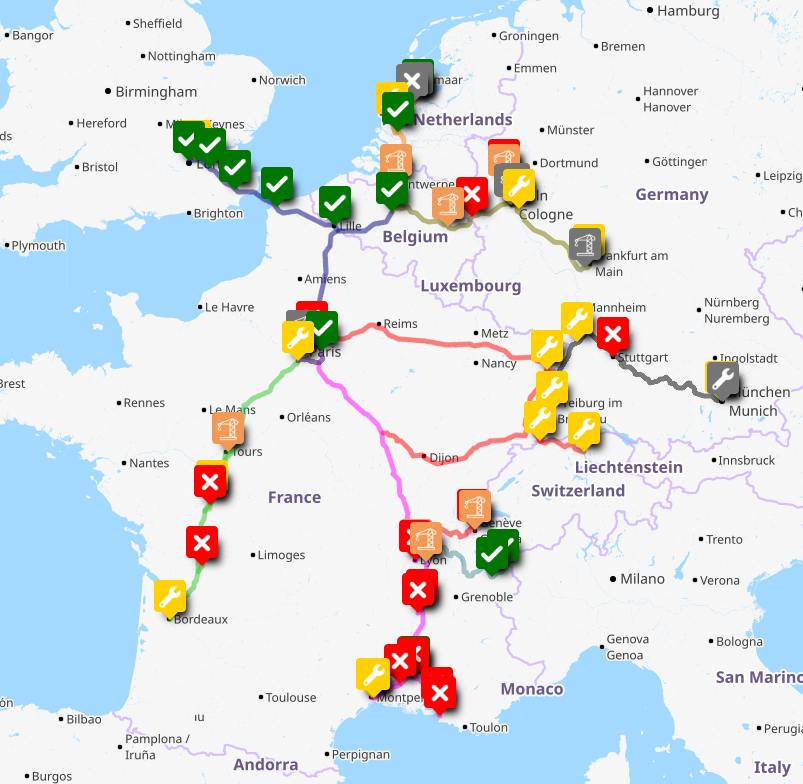
The aim in this part of the project was to establish whether stations beyond those served currently by Eurostar services could be easily adapted for Channel Tunnel services (the requirement to check passports and scan luggage before boarding), and also assess the opportunities for more trains and more stops along existing routes. All of that has now been summarised in an interactive map (click "Open caption" at the bottom of the map for the key), and the map is geographically as accurate as possible.
When the final report is finalised I will develop the point further, but I am sceptical about the potential for Lille Europe as any real alternative to direct services to London. Some activists have rubbished the idea of more direct services to the UK, instead saying "why not run to Lille and change there". But the limited terminal capacity there (something around 250 passengers) is a constraint in itself. Plus the idea to not do passport controls and bag scans when boarding, but instead disembark all passengers in Lille to do this is likewise only a partial solution, not least as doing this blocks a platform at Lille for almost an hour - and the station has only 4 platforms. So there is a need for direct services as I see it.
The Stations that have been assessed have been categorised as follows:
Fulfills requirements - this means that all the infrastructure for Channel Tunnel services is present already (essentially facilities where passengers can have their passports checked and bags scanned, and at least one secure platform where a train can be held), although of course no border police are based at some of these stations that have no services currently.
Minor adaptions - with some minor building works it would be possible for the a station to be used for Channel Tunnel services. Rotterdam Centraal offers a model for how this could be done, by re-purposing a building for a terminal and using barriers on a platform to secure it. Importantly no major changes to railway infrastructure would be needed for these stations (no new platforms or re-laying or re-organising of tracks)
Major adaptions - new platforms or re-organisation of tracks would be needed to make a station compatible, making the task harder, more expensive, more complex, or more long term than the case of minor adaptions. But it is still possible to see how the station could be adjusted, given what is currently in place there.
Full scale rebuilding - there is no obvious way for the station to be served without major rebuilding, and that of a serious scale - meaning overpasses or underpasses or major reconstruction of buildings. In some cases this could perhaps be achieved along with other re-building work that is already planned.
And the stations have then been organised into Corridors:
Core Routes - these are the routes that have been served by Eurostar from the start, from London to Paris and Bruxelles. Here the questions are the capacity of stations that are currently served (especially St Pancras, which is a major capacity constraint) and whether stations along this route currently not served could be re-opened (Ebbsfleet, Ashford, Calais) or opened (Stratford)
Paris Bypass - it is possible to route around Paris (important if crossing France towards the UK) and there are two possible stops here
South West France - from Massy TGV to Bordeaux. As Bordeaux St Jean is not too complex to adapt, this route would work, operationally, but would it work economically?
Southern France - from the edge of Paris to Lyon, Marseille and Montpellier. This was the big disappointment. Anyone who claims there will be regular London-Lyon or London-Marseille services has not examined the really problematic stations in these cities. Without major works it is hard to see how these routes work
Switzerland - not only do we know that the Swiss government is keen on these routes, but the situation in the stations looks surmountable, especially Basel and Zürich, and especially for 200m long trains. And there is the potential for stops en route in Freiburg (Breisgau) and/or Strasbourg as well, and a total of four different route variants, each with different pros and cons
Southern Germany - this a complex one. München would be possible, but would be more than 8 hours from London. Stuttgart would be 6 hours from London, but no terminal was planned when the new Stuttgart21 station was designed, and skipping Stuttgart would not be an option. Karlsruhe would however work
Western Germany - the really big prize, and with some constraints would seem to be possible - as both Frankfurt (Main) Hbf and Köln/Bonn Flughafen can be reasonably easily adapted. Düsseldorf however looks very hard, as does Köln Hbf
Netherlands - served by Eurostar already, but short term running more than one train every two hours is difficult due to limited terminal capacity. But Den Haag HS would reasonably easily offer extra capacity, were any operator to want to attempt it
So that is what I have so far. 60 stations assessed and categorised, and some effort to organise future services into corridors.
And the work on all of this will resume sometime in August once I am back from the EU's eastern borders!
P.S. If you want the background on how all of this could work, and what the legal and operational framework for stations looks like, try this analysis on my blog. It in particular explains the criteria stations have to fulfill.