Night trains, scale and standardisation

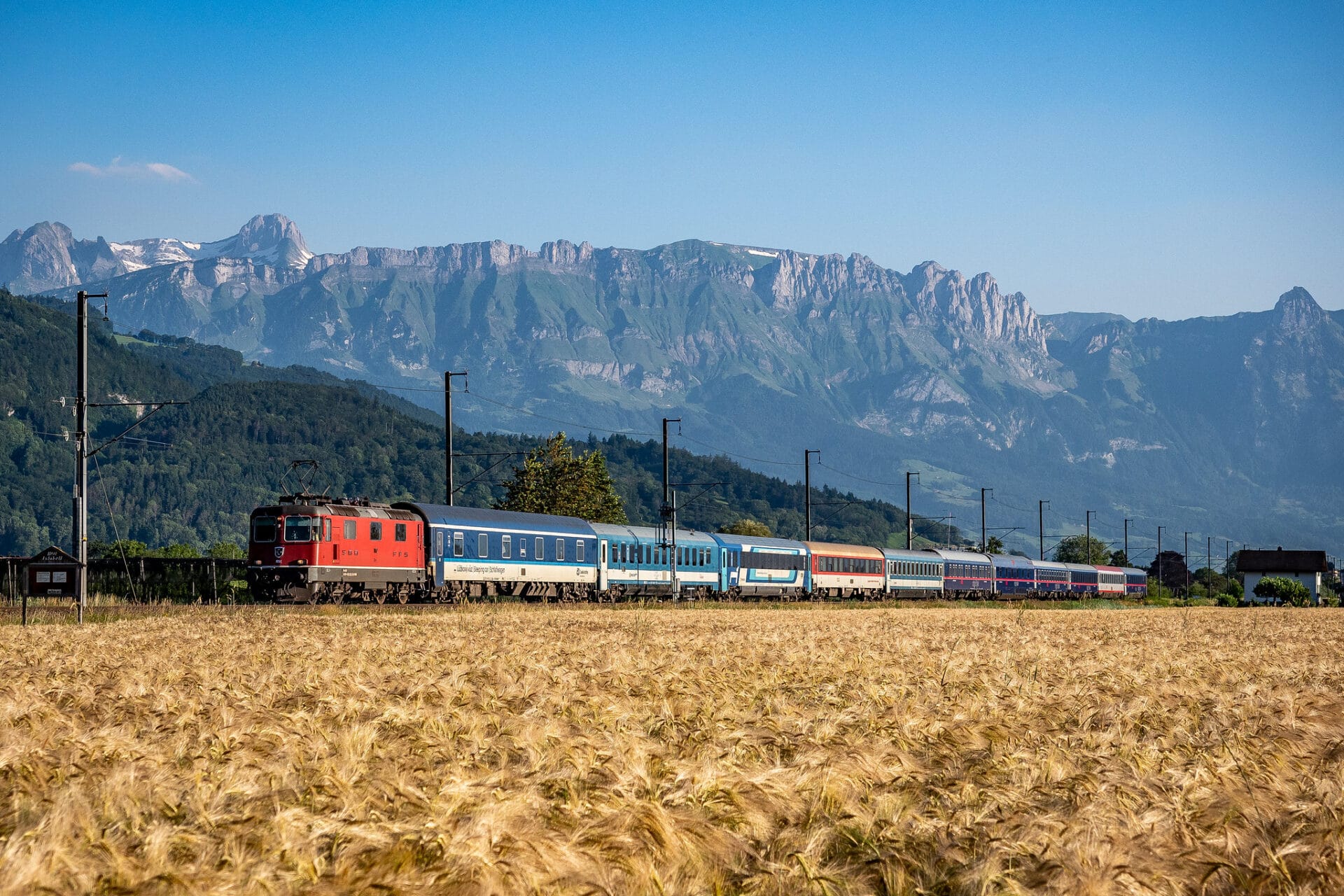
I listened in to the Back on Track Belgium conference last week, and the founder of a startup night train company said something interesting. "The reason we are against things like night train rolling stock pools," he stated, "is that means we cannot configure the trains the way we want them". We could not choose the colours or the upholstery for example he went on. I've heard this from other small players in the night train business in the past - if new trains are to be ordered, they are going to have to meet our exact specifications.
The problem is that if players in this business stick resolutely to that line, the night train conundrum is never going to be solved. And night trains are forever going to look like the one pictured: quirky, but not scaleable and not a mainstream transport mode.
I do not disagree with a potential operator's desire to configure a product, but the question is how much, and what that does to the economics of procuring new trains in the first place.
Imagine a startup wants to run a deluxe night train between Paris and Venezia, assuming that there are plenty of high wealth tourists ready to take the trip. But that 5 years down the line it turns out that Paris to Venezia is not profitable, and the market potential for ski trains between Berlin and Kitzbühel is a better bet - and that requires more compartments, but smaller ones. Can assets designed for a Paris - Venezia deluxe train be redeployed for a more basic Berlin - Kitzbühel service? If they cannot, getting finance to make the order in the first place is going to be a lot harder.
And then imagine that to rebuild the carriages for the new lower budget purpose changes the weight balance of the carriage, and so a whole new costly approval is going to be needed. Even more risk.
And is if that is not enough, what about if each carriage for each class of passengers needs to be designed differently from the start - with larger compartments and wider windows for higher paying customers? And it is impossible to know at the start how many deluxe and how many more basic carriages are needed at the start? Oh, and each of these carriage designs might need a separate costly and time consuming approvals process.
You get where I am going here. Make the design of the train too complex and too bespoke at the start and you are unlikely to be able to get the finance for the acquisition in the first place - because the product will not be adequately standardised so as to be able to redeploy it on another route if your first attempt fails.
Starting small and experimenting is also not really an option - were a startup to order 30 carriages the cost per carriage is going to be high. Order 300 and the cost per carriage - due to standardisation - is going to be low enough to make the operation economic.
So the crux as I see it is to standardise enough. Keep all the basics very standardised - the carriage body, bogies, electronics, windows, plumbing. And beyond that - in terms of the beds, upholstery, small fittings - allow as much customisation as possible. The line between what is and what is not customisable is determined by homolgation - only things that do not need a new homolgation process are what the operators can themselves customise. Sure, that might mean that some startup might not get the windows quite as wide as it wants them, but it will get the majority of what it needs for a decent price, whereas currently the operator gets nothing of what it wants because no finance is forthcoming for a product that is too bespoke, and does not benefit from standardisation and economies of scale.
Who, I wonder, is going to realise this in the night train sector? Strikes me no operator (other than ÖBB somewhat) has understood this yet.