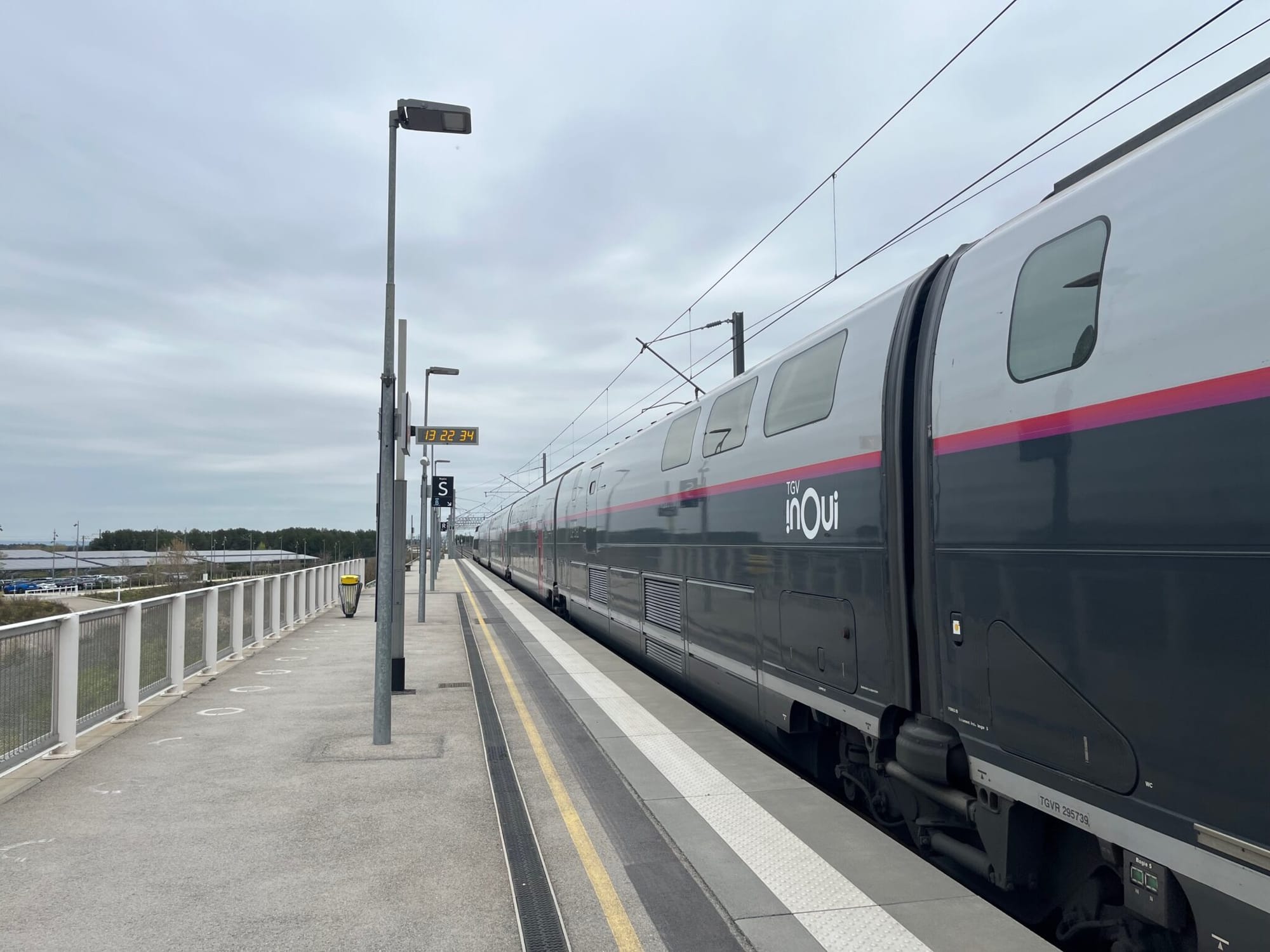
There is currently an argument in France about the future of the national railway operator SNCF that goes roughly like this: better keep the whole thing together, because then some smaller places that are not profitably served can still have their trains. If we let private companies cherry pick the profitable lines and that will not be the case, and passengers will suffer. A précis of this sort of discussion can be found in articles like this one in Le Parisien.

With my experience of rail, Europe wide, I have never really agreed with this sort of way of arguing. But let us, for the sake of the rest of this blog post, assume it is true – for the good of the future of French railways, a big, unified SNCF is better for France. And that would be better for passengers.

Then to the story that prompted this post.

A friend of mine posted in a messenger group this morning about his experience on a delayed TGV from Avignon TGV heading north through Lyon.

A passenger sat next to my friend had a SNCF TGV ticket Avignon TGV – Lyon Part Dieu, and a SNCF TER ticket Lyon Part Dieu – Mâcon-Ville, but due to the TGV delay would miss their connection onto the TER regional train in Lyon, and asked the TGV train manager whether, as a result, they could simply stay on the TGV that also stops at Mâcon-Ville*, and for that 47 minutes of extra trip sit in the bar carriage and have a coffee.

The SNCF train manager’s reaction was no, that would not be possible “because the other train is operated by another company” (it isn’t – they’re both SNCF Voyageurs – but that even being given as the rationale is interesting) and it cannot be done as the TGV the passenger is on is already full, and that if the passenger wanted to do that it would cost them €76.

Look at it this way. The passenger on the Avignon – Lyon TGV is already inconvenienced. Their train is late. The train manager could repair the issue – by letting the passenger stay on in the bar carriage. And the passenger would feel a bit better. Or the train manager could do as they did, and double down – make the problem seem like it was the passenger’s fault and not offer the passenger a solution.

And please do not try to tell me there is any safety or security problem here. Lyon Part Dieu – Mâcon-Ville is an old 160km/h line, with a max axle load of 22.5 tonnes (unlike French high speed lines that have a limit of 17 tonnes). So a few extra passengers on a TGV is no problem at all.

It is of course possible that train managers do not have the power to make a decision like this – to help a passenger with this sort of conundrum. So could be that it is the rule that is wrong, rather than the train manager’s attitude being wrong.

But in the end this all adds up to the same thing for the passenger.

SNCF in situations like this gives a passenger hostile impression. It does not want to help a passenger get to their destination. And these passengers, in the end, are voters. And when the future of SNCF becomes a political hot topic, those voters are going to go “hang on, the times I have needed it to work as a passenger friendly joined up company it did not, so why should I even care if it is still one firm – because for my sake it already does not work

So SNCF, if it wants to save itself, has to start at the bottom. It has to start with its customers, the passengers. Make them feel welcome. Give them a good case as to why the status quo is better than whatever liberalised future might be around the corner. Give them carrots, in other words.

Instead all SNCF does is paint a dark picture of the future, to which passengers can rightly say, well, hey ho, the status quo does not work for us currently, can we really imagine it would all be that much worse? SNCF’s current attitude is hastening its own demise.


* – I have no idea why the passenger did not simply book all the way to Macon-Ville in the first place, but let’s not get into that here.

10 Comments

  1. My own list of frustrations with the SNCF is endless. However, I wonder if this mix of carelessness and client adversion is really SNCF-related or rather a general attitude of many French companies. I had similar experiences with car hiring companies, and even privately owned hotels and restaurants.

    • Yes, I was wondering the same as the French are known for being arrogant but also egalitarian. it seems the train conductors are kind and helpful when it comes to ensuring comfort and safety on their own trains, but not when it comes to ensuring travellers reach their destination when passengers are inconvenienced by delays or trains being in excess of capacity.
      Again, like Jon’s original article, my sample size for this observation is small, in my case limited to this small Reddit group (apologies!)..
      https://www.reddit.com/r/opinionnonpopulaire/s/OdoT7AA23Z

  2. Max Wyss

    Actually, that train manager was not completely wrong, but he phrased it very badly.

    Even if TGV and TER are operated by SNCF, they are not the same organisation. TER are in the responsibility of the Régions, which includes ticketing as well. Other than in other countries, there is apparently no through-ticketing; the passenger had a ticket for TGV (aka SNCF Grandes Lignes (or so)) and a ticket for TER. Not only is there no through-ticketing, but they also do not accept each other tickets. This is (at least to some extent) a consequence of the TGV ticketing system (aka all-inclusive tickets, yield-managed; that’s what you get when hiring phased-out airline managers). And it is another feature of the SNCF group, to make internal pseudo-competition.

    A much more customer-friendly approach would be the separation between transportation (aka ticket; one fixed fare for any given connection) and surcharge (aka seat reservation and surcharges (which can be yield-managed)). In this situation, the passenger would only have had to pay a nominal surcharge, because he was already in possession of a valid ticket.

    This very unpleasant situation is most extreme in France, but can also found in other countries, such as Germany and Spain. For Italy, I am not quite sure.

    It definitely does not exist in Switzerland, even with surcharged services, such as Glacier Express, or Prestige Class on the Golden Pass Express. FWIW, for the latter, I travelled it a few months ago, and I had a Second Class day pass, a First Class update day pass, and the reservation for the second best seat on the westbound GPX; so, I had to show three items to the train manager; one physical, and two QRCodes… So, looking at the approaches above, this trip was under the second approach; simple, modular, and nevertheless pseudo-yield-managed.

    • “Even if TGV and TER are operated by SNCF, they are not the same organisation.” I don’t care. They are still the same operator under CIV.

      “This very unpleasant situation is most extreme in France, but can also found in other countries, such as Germany and Spain.” Spain, I don’t know, but this situation would have been handled entirely differently in Germany – the passenger would have just been allowed to stay on the high speed train, perhaps standing if necessary.

      • Max Wyss

        Operator is here in the technical sense. The TGV is operated by SNCF (operating) for SNCF Grandes Lignes, and the TER is operated by SNCF (operating) for the Région. In both cases, the VKM is FR-SNCF (for SNCF Voyageurs). The commercial authority is, however different.

        I am not sure whether the Zugchef of an ICE would let you continue if you show your Deutschlandticket for your last segment; to me, that would be a similar situation as with this passenger.

        • Not comparable, and even then if you explained to a Train Manager on a ICE and had a Deutschlandticket for the last stop, they might still let you do it. If you had regular tickets for both parts they definitely would let you.

  3. It’s not about being a different company, but simply passengers not allowed on the TGV without reservation.
    However, when the service is disrupted (cancelled TER or missed connection) it is very common that those additional passengers are allowed, either in an organized manner (bookings distributed by the departure station) or improvised by the TGV conductor saying “OK come in”.
    The passenger described here is in this kind of situation, but possibly he can have another TER less than one hour later so his situation would not be considered worthy of a replacement on the TGV.

  4. The same thing happened to me. I had a TGV ticket from Mulhouse to Luxembourg (which I had bought from DB, but that is another story). and the TGV was 2 hours late, so I decided to take the TER in stead. Same discussion. Yes it is both SNCF, no it is not the same company…

Leave a Reply to Jon Worth Cancel

Your email address will not be published. Required fields are marked *